Empecé la mañana leyendo el capítulo 9 de Tomás Nevinson de Javier Marías y me llamó la atención su descripción de María Viana: los hoyuelos apenas perceptibles y la manera en que su mirada camina por la línea fina entre el asomo de un hombre libidinoso y el retrato elegante de la belleza de una persona. Espero que hoy el estudio y la lectura puedan compensar lo de ayer, que se perdió entre distracciones relacionadas con el “business” (asi “busy”) y el desgaste inevitable de la gestión de personas.
Un viejo amigo de la escuela primaria me envió un vídeo en el que se improvisaba un motivo floral sobre un objeto, celebrando la habilidad y la espontaneidad del gesto, y afirmando que esa habilidad era un arte.. Estuve tentado de responder que se trataba de artesanía y no de lo que él llamaba arte, pero preferí callar, sabiendo que en otro contexto podría invocar esa misma artesanía como antídoto frente al charlatanismo de ciertos artistas conceptuales, y quizá incluso reivindicarla, no sin ironía, con respeto a William Morris.
Pero ¿es acaso mayor insulto callar, porque supone ignorarlo, o decirlo con franqueza para mostrar hasta qué punto nuestros caminos se han separado, algo que ya hice antes, sabiendo además que él es más bien antiintelectual? Siento el impulso de escribirle sin rodeos: “esto es artesanía y no me interesan las artesanías, por si no lo sabías”, o bien responder de forma neutral: “Sí, hay mucha habilidad en ese tipo de hacer”. Algo parecido ocurre con su gusto musical y su admiración por los solos de guitarra líder de los años ochenta, que ya no me impresionan y que percibo como cosas propias de la adolescencia. ¿Es la sinceridad y la honestidad, incluso hacia un viejo amigo, algo que ahora viene acompañado de tanta vacilación? Tal vez la vacilación no indique falta de honestidad, sino la conciencia de que decir la verdad ya no produciría ningún encuentro.
Inaction: Reading Hadot on Plotinus in the First Hours of the Year
By Justin Loke
“When people are too weak for contemplation, they switch to action, which is a mere shadow of contemplation and of reason. Since, owing to the weakness of their souls, their faculty of contemplation is insufficient, they cannot grasp the object of their contemplation and be fulfilled by it. Yet they still want to see it; and so they switch to action, in order to see with their eyes what they could not see with their spirit. In any case, when they create something, it is because they themselves want to see it and to contemplate it; and when they propose to act, insofar as they are able, it is because they want their act to be perceived by others.” (III 8, 4, 33–39)
This is not a review of the book, nor even a considered assessment of Pierre Hadot’s book on Plotinus as a whole, but merely a response to a segment I stumbled upon late last night, reading without urgency, in the first hours of the new year. It is a habit I seem to have acquired long after the drinking and parties of younger days fell away, and perhaps not entirely without precedent in older traditions, where the turning of the year called less for release than for attentiveness, for restraint in speech and gesture, for a certain care at the threshold, with 2026 already vaguely in mind as the year in which I am meant to be finishing other, heavier things.1
Plotinus writes with a severity that is so uncompromising it sometimes becomes almost funny. When he claims that “when people are too weak for contemplation, they switch to action, which is a mere shadow of contemplation and of reason,” he reverses an entire moral economy at a stroke. Action is no longer strength, courage, or engagement, but impatience, a compensatory movement for a soul unable to remain with what it sees. We act, he says, because we cannot bear contemplation long enough to be fulfilled by it. Action becomes a kind of visual aid, a way of seeing with the eyes what could not be sustained by the spirit. Even creation, in this account, is not generosity or excess, but restlessness: we make things because we ourselves want to see them, and we act because we want our acts to be perceived by others.
This is Platonism at its most extreme, pushed so far that it tips into inversion. Action is not condemned outright, but quietly degraded, reduced to a shadow cast by failed contemplation. One can almost hear the irony: the more urgent and energetic the action, the more it betrays spiritual weakness. It is not inaction that Plotinus praises, but a stillness so demanding that most souls flee from it. The rush to act becomes faintly comic, not immoral, just hurried, unable to endure the intensity of seeing without immediately externalizing it.
The same logic reappears in his account of beauty. Plotinus insists that beauty does not reside primarily in symmetry or proportion, but in an added presence, “some kind of aura,” a light that shines upon form and animates it, luminous, though not quite equal to light itself.
“Even in this world,” he writes, “we must say that beauty consists less in symmetry than in the light that shines upon the symmetry, and this light is what is desirable. After all, why is it that the splendor of beauty shines more brightly upon a living face while only a trace of beauty appears on the face of a dead man?… The living man, even if he is ugly, is more beautiful than the most beautiful statue, because life is better than stone. (VI &, 22, 24-32)”
Here again, the claim is initially compelling. Pure proportion is not enough; something lifelessly perfect can fail to move us. But the final analogy falters. A living face compared to the same face dead is an easy case. It quietly replaces the harder aesthetic question (living face versus statue) with an ontological one. Life is smuggled in as a guarantee of beauty, and the hierarchy of being is allowed to decide what perception should conclude.
I do not agree that an ugly living man is more beautiful than a great statue simply because he lives. A statue is not cold; it appears finished, but we know that for its maker it is always unfinished, or rather, it accepts its incompletion, abandoned by the artist in the way Giacometti leaves a figure unresolved, or the way Paul Valéry speaks of abandoning a poem rather than finishing it. It is a sentence with parts best left unsaid. As La Rochefoucauld reminds us, eloquence lies in knowing what not to say. It does not lack light; it refuses transcendence. What Plotinus distrusts, here as elsewhere, is anything that might rest in itself, anything that does not point upward or demand completion elsewhere. Life, movement, action, illumination, all are valued because they refuse closure. An ugly man, by contrast, is an actuality, the realization of a failed ideal, failing even to fulfill the idea of ugliness itself, something that being alive cannot compensate for.
This is where Plotinus becomes most revealing. His philosophy is not wrong so much as excessive. It is so faithful to contemplation that it must demote action, so faithful to ascent that it must suspect form, so faithful to life that it must slight the completed object. The arguments are beautiful. One could admire the purity while smiling at Plotinus’s impatience in advocating contemplation and derogating action.
It is worth recalling that the association of the New Year with excess (drinking, noise, release) could be relatively recent. In older ritual traditions, particularly within Confucian culture, the turning of the year was treated as a threshold rather than a rupture. One was careful with words, gestures, and conduct, as if the opening days set a tonal pattern for what followed. Feasting existed, but it was governed, not compensatory. The modern New Year, by contrast, bears the mark of fatigue: a sanctioned interval of excess that answers the pressures of work and accumulation. What now appears as celebration once functioned more as alignment. ↩︎
The Retreat of Reality: On Agamben’s What is Real? (2018)
by Justin Loke
For much of Western thought, reality was understood as something necessary, of necessity: things happened for reasons, and even if humans did not yet know those reasons, they were assumed to exist. This view goes back to Aristotle, who described reality in terms of potentiality (dynamis) and actuality (energeia). For Aristotle, potentiality was not just the chance that something might happen; it was a real capacity that also included the power not to happen. A seed could become a tree, but it could also remain a seed. Meaning arose from this relation between what can be and what need not be. Agamben’s core idea of potentiality is not the same as probability. Potentiality means a real capacity that also includes the power not to pass into action (can be / can not be). Probability, by contrast, is a measured likelihood inside a system designed to predict and produce outcomes. So probability is a tool of operativity; potentiality is a deeper openness that resists being reduced to outcomes.
Modern science originally shared this belief in necessity. Its task was to discover the laws that made events inevitable. Quantum physics, however, breaks this picture. At the atomic level, scientists can no longer say what is happening, only what is likely to happen. For example, you cannot know both an electron’s exact position and its exact motion. Scientists no longer say “the electron is here,” but “the electron is likely to be here.” Nature itself does not allow such certainty. Based on the uncertainty principle: reality cannot be fully known as determinate. Instead of necessity, science works with probability. At this scale, particles no longer appear as definite objects but as statistical distributions, described not by what is but by what may occur.
This shift does not weaken science; it strengthens it. Even if individual events are uncertain, large numbers allow outcomes to be engineered with remarkable reliability. Modern technologies, from nuclear power to nuclear weapons, depend on this logic. Reality retreats, but control increases. Science no longer reveals truth in the classical sense; it manages uncertainty.
Ettore Majorana, the physicist at the centre of Agamben’s What Is Real?, grasped this problem with unusual clarity. He argued that probability was not merely a limit of human knowledge but a feature of reality itself. If the world is fundamentally probabilistic, the scientist no longer stands as a witness to truth, but becomes a technician of models. Agamben reads Majorana’s mysterious disappearance not as an accident or suicide, but as a symbolic gesture: the subject of science disappears along with reality.
Simone Weil sharply criticizes this transformation. She observes that science has abandoned the search for necessity, which once gave meaning to the world (the sense of “it must be so,” which gives meaning). Modern science explains how often things happen, not why they must happen. It becomes effective but spiritually empty. For Weil, when necessity disappears, meaning disappears with it.1
To reiterate, probability is not the same as potentiality. Probability is calculated, measured, and used to produce outcomes; it belongs to systems of prediction and governance. Potentiality, by contrast, includes the capacity not to act, not to pass into actuality. For Agamben, a proper life lies in potentiality, not in probability. So what do we mean by “real” now: reality is no longer something stable and necessary that truth reveals; it becomes something managed through statistical prediction.
This led me to think about how Borges shows that worlds can be “real” because a system, such as an encyclopedia, a language, a model, takes hold and organizes life, fiction becoming reality. In stories such as Tlön, Uqbar, Orbis Tertius, a fictional system becomes real because people begin to be enveloped by it. An invented encyclopedia begins to determine how people think, speak, and study, until its fictional world becomes more operative than the one it displaced..2
What seems important here is the difference between fiction becoming reality and the idea, often stated cynically, that reality itself has become fiction. The latter expresses a kind of resignation: that nothing is true anymore, that everything is just narrative, and that belief no longer matters. It dissolves responsibility by flattening truth and fiction into the same indifference.
What Borges points to is something more precise and more troubling. Fiction does not replace reality, nor does it expose reality as mere illusion. Rather, constructed systems gradually take on the weight of reality because they are used, inhabited, and relied upon. Reality is not negated but produced: worlds come into being not through truth, but through their capacity to organize life.
When people say “reality is fiction,” they usually mean it in a cynical way. It suggests giving up: that nothing is really true anymore, that everything is just spin, stories, or opinions, and that believing in anything is pointless. It treats the world as fake and assumes there’s no reason to take truth or responsibility seriously.
“Fiction becoming reality” means something else entirely. It doesn’t say the world is fake. It says that ideas, models, and stories can slowly start to shape how people live, until they function as reality. A system may begin as an invention or theory, but once people rely on it, organize their lives around it, and act as if it were real, it becomes real in practice. The danger here isn’t illusion, but effectiveness: things gain power not because they are true, but because they work and are widely used. We can start thinking the “real” is produced and maintained.3
Is Agamben warning us that modern reality increasingly functions in this way, constructed like fiction, yet enforced as truth? It is assembled from models, probabilities, and scenarios, structures that resemble fiction in their construction but are enforced as unquestionable reality. This is not a claim that nothing is real. It is a more uncomfortable insight: that reality today is often something made, stabilized, and governed, and that the task is not to deny it, but to learn how to live within it without being entirely absorbed by it.
The world is not fake; it is being shaped by what people use and believe to be true. And truth (before we draw distinctions between the true and the real, often assumed to be synonymous) has always been constructed through language. We describe and name the world through words from the very beginning; we have never encountered it without them. What has changed is not that reality has disappeared, but that its construction has become increasingly technical, probabilistic, and governed. The task, then, is not to retreat into cynicism, but to remain attentive to how reality is made, and to how one might live within it without surrendering entirely to its mechanisms.
“Desde el fondo remoto del corredor, el espejo nos acechaba. Descubrimos (en la alta noche ese descubrimiento es inevitable) que los espejos tienen algo monstruoso. Entonces Bioy Casares recordó que uno de los heresiarcas de Uqbar había declarado que los espejos y la cópula son abominables, porque multiplican el número de los hombres. Le pregunté el origen de esa memorable sentencia y me contestó que The Anglo-American Cyclopaedia la registraba, en su artículo sobre Uqbar. La quinta (que habíamos alquilado amueblada) poseía un ejemplar de esa obra. En las últimas páginas del volumen XLVI dimos con un artículo sobre Upsala; en las primeras del XLVII, con uno sobre Ural-Altaic Languages, pero ni una palabra sobre Uqbar. Bioy, un poco azorado, interrogó los tomos del índice. Agotó en vano todas las lecciones imaginables: Ukbar, Ucbar, Ookbar, Oukbahr… Antes de irse, me dijo que era una región del Irak o del Asia Menor. Confieso que asentí con alguna incomodidad. Conjeturé que ese país indocumentado y ese heresiarca anónimo eran una ficción improvisada por la modestia de Bioy para justificar una frase. El examen estéril de uno de los atlas de Justus Perthes fortaleció mi duda.” Tlön, Uqbar, Orbis Tertius, 1940 ↩︎
I began to think about money, about currencies, as a promise, and about the creation of debt. Money is not powerful because it is true, but because it works. A banknote, a digital entry, a currency has no intrinsic reality beyond the system that sustains it. It is a promise, backed not by substance but by collective belief, institutional enforcement, and habitual use. Money becomes real because it circulates, because it is accepted, because lives are organized around it. Its power lies not in truth, but in effectiveness. Currency is therefore one of the clearest examples of fiction becoming reality. ↩︎
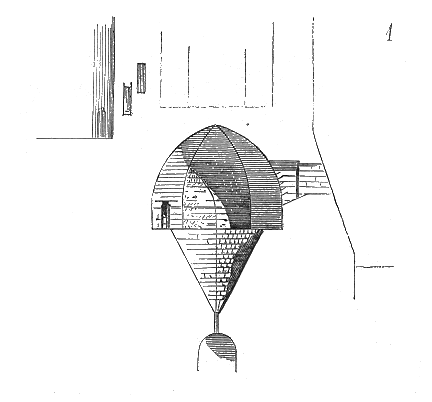
“Diagram of an alleged oubliette found in the Bastille prison in Paris, from Viollet-le-Duc (1854–1868) the commentary speculates that the structure depicted, may actually have been an ice well built to keep ice. If so, whether or not it was known to also have been used as an oubliette is not clear” 1.
“ […] A medieval glossary explains the meaning of the neologism dementicare, which was beginning to substitute the more literary oblivisci in common usage, as follows: dementicatis: oblivioni traditdistis. The forgotten is not simply cancelled or left aside: it is handed over to oblivion. The pattern of this unformulable tradition was set out by Hölderlin in his notes to the translation of Sophocles’ Oedipus where he writes that God and man, ‘in order that the memory of the heavenly ones not vanish, communicate in the form, all-oblivious, of infidelity.2
“Fidelity to that which cannot be thematized, nor simply passed over in silence, is a betrayal of a sacred kind, in which memory, spinning suddenly like a whirlwind, uncovers the hoary forehead of oblivion. In this attitude, this reverse embrace of memory and forgetting that holds intact the identity of the unrecalled and the unforgettable, is vocation.” – The Idea of Prose, p.45
An oubliette is a specific kind of dungeon: a small, often bottle-shaped room accessible only through a trapdoor in the ceiling, built so that a prisoner could be forgotten. The word comes from the French oublier, “to forget.” An oubliette is thus not merely a chamber beneath a trapdoor but the architecture of forgetting itself, a place where one is locked, and drift quietly towards oblivion, the same Indo-European root that gives us oblivisci, to slip from memory, and dementicare, to un-mind, to release something from the charge of recalling. Dementicare (perhaps like dementia) is not just to forget, not a careless loss, but to hand-over to oblivion. All three terms cluster around the semantic field of forgetting.
From the text above, on the sense of vocation, it is where the call is inseparable from the possibility of its own suspension: the person in the oubliette inhabits the moment when one’s name, task, or summoned purpose hovers between being remembered and being released from it, neither renounced nor fulfilled, simply waiting in the dim interval where abandonment and destiny briefly coincide. Perhaps the task of a poet or an artist is not to declare truths, not to recite doctrines, and all the more not to be soaked in activism now, or to share a personal trauma explicitly, to lament marginality, or to act as the great moralist on social media. It is not to fix memory, or to flirt with the posture of an archivist while lacking the dedication and obsession of a true archivist.
It is to bear witness, to bear witness to what can neither be fully remembered nor truly forgotten. The poet is not faithful to the content of memory but to the tense movement between presence and absence, between remembering and forgetting, holding the unsaid together with the unforgettable. Yet perhaps the only true witness is the dead witness.
“To what is the poet faithful? What is the question here is something that cannot be fixed in a proposition or memorised as an article of faith. But how can a vow be kept if it is never formulated, not even to oneself? It would have to quit the mind n the very moment it affirms its presence there. […]”
Is he saying that memory is preserved through a kind of forgetting, and that the relationship between gods and humans is sustained not by perfect fidelity but by a necessary, paradoxical “infidelity.”? ↩︎
“These bonds are shackle free Wrapped in lust and lunacy Tiny touch of jealousy These bonds are shackle free”
– Placebo
Luna, lunes, Monday, and lunacy all trace back to the Latin lūna, “moon,” an old word that shaped both calendars and metaphors. Spanish lunes descends directly from diēs Lūnae, “the day of the Moon,” while English Monday mirrors the same pattern through Old English Mōnandæg, a Germanic calque meaning “Moon’s day.”1 German Montag follows the identical logic: Mond (moon) + Tag (day). Even lunacy preserves the old belief that lunar phases could disturb the mind, stemming from Medieval Latin lūnāticus, “moonstruck.” It is strange, then, how all these moon-days align in my head, so much so that I find myself thinking of the Mondays on a Wednesday.
Note: A calque is a word or expression created by literally translating the parts of a term from another language. ↩︎
“It is not because life and death are the most sacred things that sacrifice contains killing; on the contrary, life and death became the most sacred things because sacrifices contained killing. (In this sense, nothing explains the difference between anitquity and the modern world better than the fact that for the first, the destruction of human life was sacred, whereas for the second what is sacred is life itself).’” – Giorgio Agamben, *Se, p.136, Potentialities
I first read this passage of Agamben back in 2011, when I was in Melbourne for about a month. I used a pencil to draw faint vertical lines on the brick wall of where I was housed, counting down to the day I would leave (not knowing what was to come over the next ten years of my life after I left Melbourne). It was a private joke between me and my roommate, the same person with whom I drank cheap supermarket white wine that cost less than bananas.
More than a decade later, I still cannot say I have fully understood the passage. But each time I return to it, one idea continues to unsettle me: life and death are not sacred because they are precious; they became sacred because sacrifice contained killing.
Before encountering the passage, I assumed, like most people, the opposite. I thought ancient people considered life inherently sacred, and that is why they ritualised and protected it. Agamben turns this upside down. In antiquity, it was precisely through killing, through the ritual destruction of life, that the sacred appeared. Sacrifice did not protect life; it made life meaningful by destroying it in a consecrated way. Killing was not simply violence; it was a divine transaction.
This explains something essential about the ancient world: the destruction of human life could itself be a sacred act.
Modernity is the exact inversion. Today, life itself is sacred, individual, inviolable and to be protected at all costs. If antiquity sacralised life through its destruction, modernity sacralises life through its preservation. Agamben captures this contrast with clarity: in antiquity, the destruction of human life was sacred; in modernity, what is sacred is life itself.
I relate this inversion to the disturbing figure of the man who can be killed but not sacrificed.
He belongs to neither world. In antiquity, killing him is not murder because he stands outside the civic order. Yet, absolved from murder, his death is also not sacrifice because it carries no ritual value. His death has no meaning, neither legal nor divine. He is the one who can be killed but never consecrated, who is exposed but not redeemed, who is alive yet abandoned.
What strikes me most is how Agamben links this ancient figure to our modern world. I need to memorise it like how people used to remember phone numbers: antiquity gave life its sacred meaning through sacrifice, and modernity life itself is sacred. To remember in my own words: sacrifice gave life its sacred aura in antiquity. The disappearance of sacrifice made life itself sacred in modernity.
Writing these notes is a reminder to myself that Agamben is identifying a structure that still operates today, wherever people are excluded, detained, dehumanised or rendered killable without consequence.1 The sacred is not an inherent property of human life; it is the shadow cast by the political decisions that determine what kind of life counts. And yet, even as I try to articulate this, I feel I am saying too much and too little at once. The confusion remains, and phone numbers are not remembered with variations unless it is a futile attempt to recall the forgotten number I had not dial for years. Others I remember by heart, but no longer recall whose they are.
The word caesuras comes from the Latin caesura, which means “a cutting” or “a break.” It is built from the verb caedere, meaning to cut, to strike, even to kill.
The term Caesarean section is commonly believed to come from the birth of Julius Caesar, but this is almost certainly a legend. The real origin lies in Roman legal and medical terminology. The Latin verb caedere means “to cut,” the same root that gives us caesura. From it came the term caesus (“cut”) and the Lex Caesarea, a Roman law requiring that if a pregnant woman died late in pregnancy, the child had to be removed from the womb before burial. This procedure came to be referred to as a caesarean birth, not because Caesar was born this way, but because the word caesarean already meant “from cutting” in a medical and legal sense. Over time, the phrase Caesarean section came to mean the surgical delivery of a baby through incisions in the abdomen and uterus.
In classical poetry, a caesura was the deliberate pause inside a line of verse, the small internal rupture that alters the rhythm, as if the poet had made a slight incision in the meter. Although a Caesarean section and a caesura belong to different worlds, they share a deep etymological and metaphorical root in the Latin word.
A Caesarean section is literally a cut that brings a life into the world. Both the surgical incision and the poetic pause involve an interruption of continuity, a moment in which something is opened by force in order to bring something else into being.
In poetry, a caesura introduces a pause that reshapes how the line breathes. In childbirth, a Caesarean section is an incision through which the infant is opened to the world to take its first breath. In both cases, the cut is not merely a break but a threshold, a crossing from one state to another. The poetic line after the caesura is subtly changed, just as life after a Caesarean is altered by that necessary rupture. Perhaps their relationship is not accidental. Both name cuts that create, ruptures that produce new meaning or new life. A cut can be violence, but it can also be a beginning, and poetry quietly preserves this idea whenever its pauses are called caesuras. Yet caesuras are not simply pauses; they are the subtle breaks that hold a structure together by interrupting it, the faint discontinuities where breath gathers before meaning resumes. As I write, I think of my two daughters, both born by Caesarean section, and of the ruptures and continuities that came with their arrival, the incisions that brought them into being, and the renewed structure of life that followed.
Agamben writes of caesuras as thresholds in time, the small fractures through which experience reveals its concealed architecture. This gestures toward what lies beneath them, toward the structures that surface only in moments of interruption. Hypostasis, so often rendered as “foundation,” is less a base than a standing-under, something that quietly supports without ever announcing itself, like a shadow cast by thought.
These notions permeate the texture of ordinary days. A life is shaped as much by its interruptions as by its continuities, by what lies beneath as much as by what stands before us. Even the smallest encounter, a corridor dimmed by overcast clouds outside, a voice speaking without any intention of profundity, can become a hypostasis, a hidden underpinning recalled only years later, when one finally has the patience to read the intervals rather than the lines.
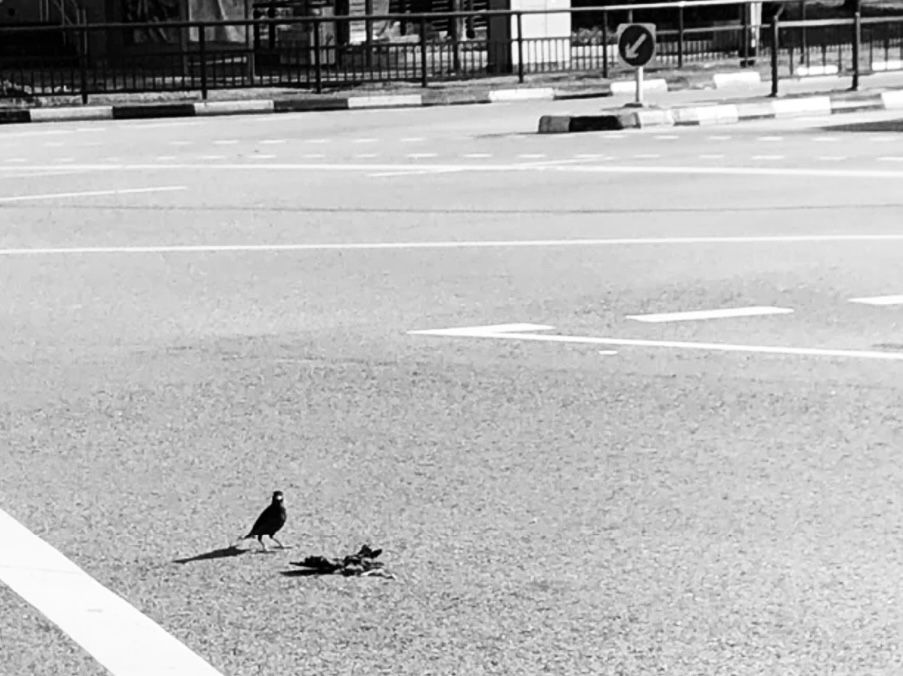
I often see roadkill on the streets of Singapore, small animals, mostly birds, often pigeons or Javan myna. They’re not just struck dead, but slowly obliterated by the endless stream of cars, until all that remains is a dark, indistinct smear on the asphalt. As a child, I was once told there’s a superstition about such sightings that when you pass by roadkill, you must spit, or at least brush the top of your head with your hand, to ward off bad luck. I find myself thinking of George Bataille’s idea of the formless (informe), that image of a “crushed spider or a glob of spit,” formlessness as rebellion against “the mathematical frock coat of ordered thought.”
Just as this passed through my mind, I noticed a pigeon on the right lane, not standing, not walking, simply crouched low. Flattened in posture, breast pressed against the road, as if brooding over a nest that wasn’t there. Or perhaps, this is how old pigeons choose to die. As if this lane, this strip of asphalt, were a designated space for avian suicide. An Anna Karenina moment, only it’s not a railway, but a three-lane road.
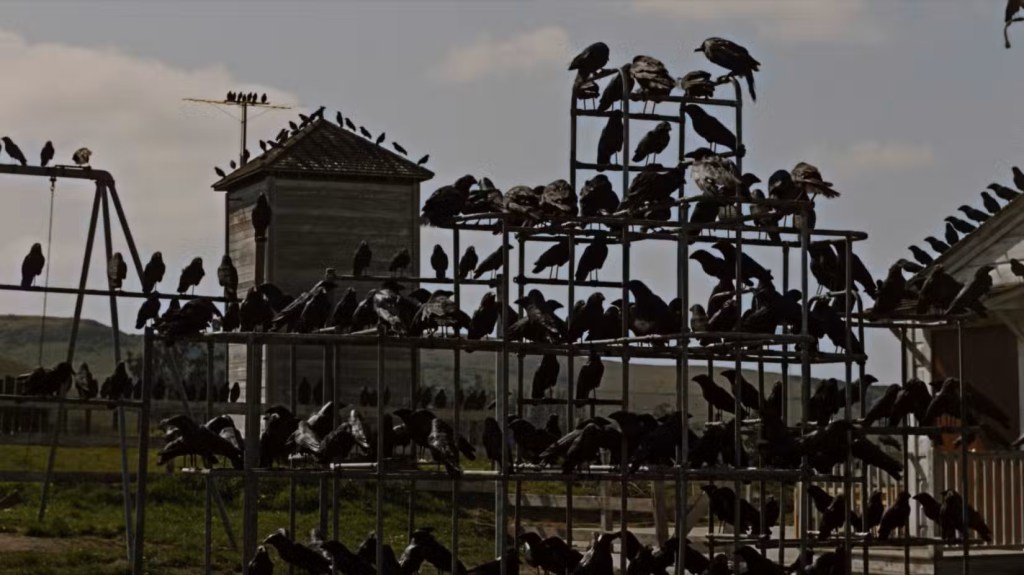
For a second, it felt Hitchcockian, but reversed. Not birds attacking humans, but birds surrendering to motorways and death. An unreal procession, a secret rite. Old pigeons lining the road not in flight, but in stillness, waiting not for crumbs, but for wheels. The horror is no longer how the birds might harm us, as in the movie The Birds, but how we could be reminded of unavoidable death.
In this imagined scene, the road stretches ahead, dotted as far as the eye can see with birds flattened, their bodies fused into the asphalt like faded stains. The surface is speckled with pale grey against a stretch of dark grey. Feathers, soft pink smears, and dark rust-red crusts lie dried and flattened across the road. A length of asphalt stippled with the light remains of creatures that once flew. I found myself guessing how many days it had been there, when one could just as easily wonder about the time that remains, the compression of meaning into the present moment.
Mapping the Ontological Apparatus Aristotle Aquinas Hegel Heideger Agamben
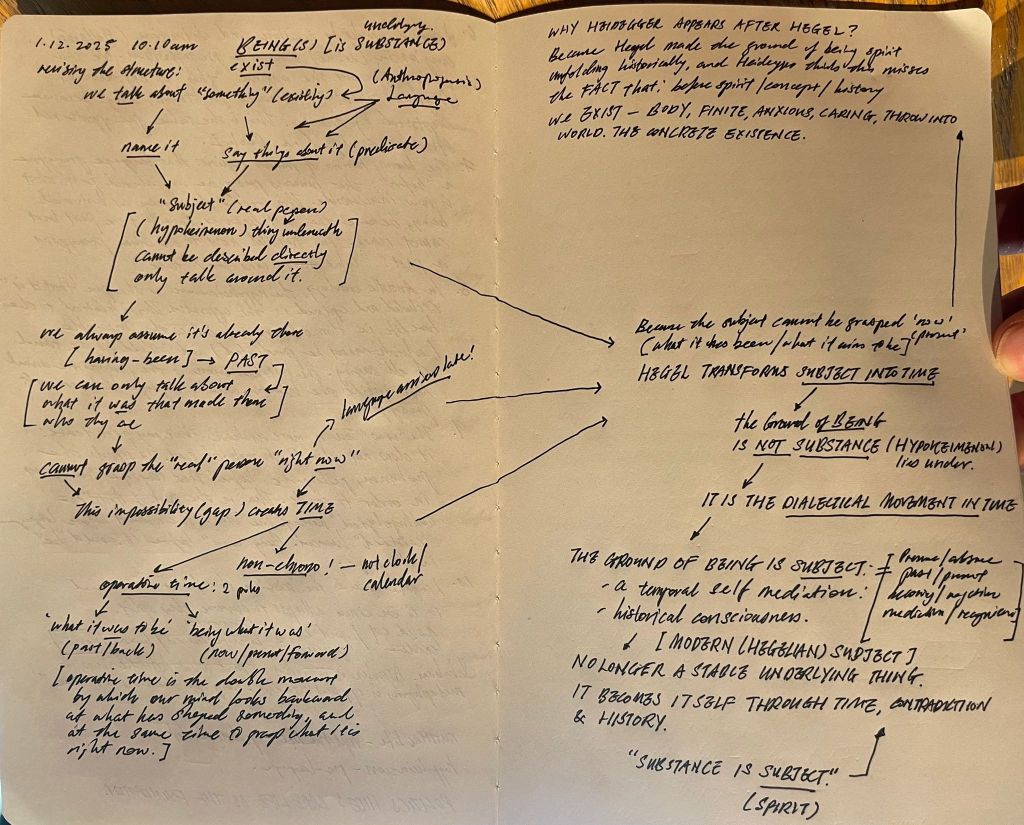
Whenever we speak about a person or a thing, we unknowingly perform two moves. First, we name it (“Katie,” “this person here”), which singles it out. Second, we say something about it (“she is kind,” “she is tall”), which assumes that there is already a stable “someone” underneath our words.
Aristotle
Aristotle noticed this and said: beneath all our descriptions there must be a subject (a “this-one-here”) that is already there before we speak. This hidden “underlying thing” is what he called substance. The problem is: this “real thing underneath” can never actually be spoken directly. You can only presuppose it.
Because language can never touch the real subject head-on, we experience it as something that has already happened. It becomes a “what it was”, a past, something already formed before speech. This simple gap, between the person we talk about and the real person we cannot grasp, quietly creates our sense of time. The present moment always runs slightly behind; who someone “is now” always echoes who they “were.”
Aquinas
Aquinas keeps this Aristotelian structure but adds a theological twist: what something is, its essence, comes from God, while its existence comes from being created by God. Essence and existence are not the same. This doubles the gap. A thing is what it is, but only because it has received its being from elsewhere. This reinforces the idea that the true core of a person is both prior and unreachable, known only “in the divine light.” So Aquinas deepens the sense of an underlying subject that cannot be fully articulated in language.
Hegel
Hegel turns this whole structure inside out. He says: the “subject” is not a stable thing hidden under our words, it is a process, something that becomes itself through time, contradiction, and self-reflection. What Aristotle treats as a fixed base, Hegel treats as a movement. The gap between what someone is and what they were is not a problem, it is how consciousness itself unfolds. For Hegel, the subject is this unfolding: a living story, not an inert support. Time is no longer a side-effect of language but the very medium in which the self becomes real.
Heidegger
Heidegger then enters after Hegel because he realizes something deeper: the entire history of Western thinking—from Aristotle to Aquinas to Hegel—has taken for granted that being must be grasped through this subject–predicate structure, where something always lies underneath what we say. Heidegger tries to step outside this heritage. He argues that our sense of time comes not simply from grammar, nor from a theological essence, nor from Hegelian history, but from the way being shows itself and withdraws, always partially hidden.
In other words, for Aristotle, the subject is the hidden thing underneath; for Aquinas, its essence and existence come from God, deepening its hiddenness; for Hegel, the subject is not a hidden thing but a temporal process. In Heidegger:,the very attempt to ground being in subjects or substances is the problem; time arises from how being reveals and conceals itself.
What ties them all together is this simple human reality: when we speak, the real person slips slightly out of reach.
We can only describe them through what they have been, through traces and stories. This small slippage, this impossibility of grasping the “pure now”, creates the line of time we live inside. Our sense of identity, memory, and history all originate from this gap.
In short, naming gives a unique individual, speaking about them presupposes a hidden core, this core cannot be spoken directly, so it becomes something “already past,” and this “already past” becomes what we experience as time.
[The ancient Greek philosopher identified what lies under, a theologian deepened the substance in relation to God, a Prussian philosopher who saw Napoleon in Jena – Weltgeistes zu Pferde – turned it into a dialectical historical process, and the German (related to the Nazis, unfortunately unlike how Aristotle was related to Alexander the Great) tried to explain the ground that makes all of them think this way.]
Giorgio Agamben ties the entire chain together. For him, this split produced by language, between what something is and the silent subject we must presuppose, creates a gap that can never be closed. That gap becomes time, and time becomes the way we understand ourselves as beings with a past, a becoming, a story. This is why he calls it an ontological apparatus: language itself generates the subject by pushing it into time and forcing life to be narrated as “what it was to be.”
And this is also anthropogenesis: the human emerges at the moment language divides us from ourselves, when the spoken “I” and the silent, unreachable subject no longer coincide.
We become human precisely in the fracture that makes us historical beings, always interpreting who we are through what we have been.
Every person carries within them a quiet shape, a way their life has carved them into who they are. It is not just the fact that they exist, but the particular texture of their existence: the small decisions, the losses survived, the habits formed, the joys that stayed, the wounds that never fully closed. Aristotle’s old phrase, to ti ēn einai, simply tries to name this: what it was for this person to be themselves. It is the inner contour of a life, the way the past leans into the present, the way someone’s ‘having-been’ silently informs their being. It is not an abstract essence but a lived one: the quiet truth that each individual becomes who they are through the unfolding of their own story.
What is Dative?
When the ancient Greeks wanted to talk about something that belonged to a person, or something that mattered for a person, they used a special form of a word that meant “for him,” “for her,” or “for this thing.” Instead of adding a separate word like “for” or “to,” they changed the ending of the word itself. So if Aristotle said “for Socrates to be Socrates,” he would mark “Socrates” with this special form. Agamben’s point is that when Aristotle talks about someone’s essence (their “what it was to be who they are”) he uses this same structure. It’s as if Aristotle is saying: “For this person, what did it mean to become themselves?” The grammatical marker simply shows whose life, whose being, whose essence we are talking about.
The Essence: “what it was to be”
Aristotle has a strange way of talking about what something truly is. Instead of saying “the essence of a thing,” he uses a phrase that literally reads: “what it was to be.” At first glance it sounds backward, as if he were talking about the past rather than the present. But what he really means is something much more intuitive: every person or thing has a quiet history built into it, a kind of inner story that explains how it became itself.
Curt Arpe noticed that Aristotle’s expression only makes sense if you understand it as answering a very personal question: What did it take for this particular being to be what it is? For Socrates to be Socrates. For Emma to be Emma. Not a generic definition, but the unique way a life has unfolded. In this sense, a person’s essence is not an abstract label but the shape of their becoming, the way their past leans into their present and quietly defines them.
The short note that follows reinforces this reading. Aristotle, in other works, uses the same kind of expression to describe what something truly is “for” the thing itself. He isn’t concerned with universal categories but with the inner meaning of each individual being. And because his phrase blends the sense of “is” and “was,” it suggests a simple truth: that who we are now is inseparable from what has already formed us. Our essence is not a static definition but the story of what it took for us to become ourselves.


 illiteratus.com
