illiteratus.com

Unauthorised Translations. Fractured Philology.

  • The word understand means position. In Old English, understandan is composed of under and standan. Yet under did not simply mean beneath. It could also mean among, between, in the presence of, or in proximity to something. To understand was therefore not to grasp an idea, but to stand within it.

    The image is spatial before it is conceptual. One stands among things, takes a position in relation to them. This movement belongs to the Germanic languages. Knowledge is imagined as dwelling. One does not seize an idea; one enters its field.

    Only later does the word comes to mean comprehension, interpretation, intellectual mastery. This differs from the Latin tradition. Comprehend, from comprehendere, means to seize together, to take hold. One tradition imagines thought as grasping; the other imagines thought as standing. The distinction is small, but consequential. To understand is perhaps not to dominate an idea, but to remain within it long enough for its contours to appear.

  • If you haven’t painted grey, Cézanne said, you are not a painter. Perhaps the same could be said of thinking itself. Why should a single colour be a criterion?  This statement is not a proposition but a provocation. Yet thought repeatedly returns to grey. Think of the colour of the shadows in Plato’s cave. Hegel writes:

    “When philosophy paints its grey in grey, one form of life has become old, and by means of grey, it cannot be rejuvenated but only known.”

    Grey is not a colour one encounters directly. It appears in weather, dust, concrete, old photographs, and the residue left behind. It is neither night nor day, neither black nor white, neither despair nor optimism. Grey is what emerges when oppositions grow tired of themselves. Perhaps philosophy turns grey because it arrives too late, when life has already grown old.

    In the tropics, grey is the colour of approaching rain, overcast afternoons, unfinished buildings, and the map-like shapes that humidity slowly draws upon walls. One does not choose grey. One eventually notices that one has been living inside it for some time, despite the sunburn.

  • In Greek, aphōrismenos means separated, set apart, marked off, a boundary. It is formed from apo, away from, and horizō, to divide, determine, draw a line. The same root as horizon, the line that separates earth from sky.

    An aphorism belongs to this too. Before it became a short saying, aphorismos meant a definition, a delimitation. In Hippocratic medicine, it named concise statements that distinguished one condition from another, one symptom from the next. The aphorism describes and separates.

    A horizon divides a landscape. A definition divides a concept. An aphorism divides thought.

    It is brief but not incomplete. It is bounded. The aphorism does not attempt to say everything. It marks where one thing ends and another begins.

    The shortest sentence is sometimes a line drawn around an abyss.

  • “My reading has left impressions upon me as much as I have left impressions upon the books. A tattered copy of E. Starkie’s B. and a heavily marginalia-laden copy of B.’s Reflections have accompanied me for years, shaping me much as prolonged sitting shapes an armchair. The cushion bears the imprint of the body only briefly, but the chair slowly shapes the spine that leans against it for part of a lifetime.”

  • by Justin Loke

    He had come to believe, not without a certain embarrassment, that what he required was documentation. It was something stamped, laminated. It was for this reason, or so he later insisted, that he found himself one morning at the embassy, among others whose faces bore the same provisional quality. He carried with him a borrowed sense of purpose.

    The photographic booth accepted his coins, though not without that brief and familiar interval in which they were swallowed but not yet acknowledged, a hesitation he associated with vending machines, slot machines, and other apparatuses of exchange, whose silence seemed to imply the possibility of loss.

    Inside, beneath the curtained enclosure, he arranged himself as instructed, while the machine recorded him. The resulting image, when it emerged, presented a version of his face with a clarity that struck him as excessive and lacking at the same time. When the flash went off, he smiled, recalling that such expressions were not always customary, that early photographic processes required long exposures, during which subjects were held in place, making neutral expressions more practical, while portraiture itself inherited from painting a preference for dignity over spontaneity, a convention that persisted even as technology improved, later reinforced by mid-century injunctions, perhaps even commercial in origin, promoting the cheerful, smiling subject, to say cheese—a word designed less to express happiness than to produce its visible form… but he smiled.

    He noticed butterflies gathering by the window, their movements uncertain. He recalled that hope had once been described to him as feathered, “Hope” is a thing with feathers… a phrase he had first encountered in a song and only later discovered to have originated in Emily Dickinson. It was in this spirit that he dreamed himself aiming a gun at her heart, only to find that what issued forth was not force but a small flag, on which the word BANG had been printed in childish letters.

    From a distance, he organized his days around the anticipation of a sentence that had not yet been spoken. The mornings extended themselves with elasticity, the afternoons were sustained by imagined conversations whose details he revised continually, and the evenings… the evenings… safer to take the pills.

    He told her that he had just returned from a thousand-year time trip, and he told her what he saw: in that place, children moved in pairs holding hands, children kissing… untroubled by the presence of others; there, it seemed that everyone was happy and would live forever, and all their dreams would come true.

    Yet the illusion betrayed itself in minor details, and he understood wth clarity. He was swimming, while the air around him carried a faint residue of alcohol. The whiskey was ice cold, but he felt a slight burning in his throat, and then, almost immediately, found himself recalling the warmth spreading through the water when he had realised he was pissing in his trunks at the pool.

    He recalled that day, from a distance, he saw her ascend the diving board, where she paused, suspended between the act of stepping forward, the possibility of retreat. In that moment, she appeared to gather a certain light before the descent, though whether it belonged to her or to the conditions of observation, he could not say.

    He set about reconstructing his day with a care, ensuring that each hour was aligned with the prospect of her return. As evening approached, and the distinctions between the day’s segments began to dissolve, he found himself once again repeating the sentence upon which everything seemed to depend. It struck him, not without a certain irony, that the phrase was fragile. In this way, he held it in place, as one might hold a structure together through sheer attention: that she would come back to the house that night.

    Adaptated from lyrics of Without Feathers by The Wave Pictures after listening to it for 16 years.

  • by Justin Loke

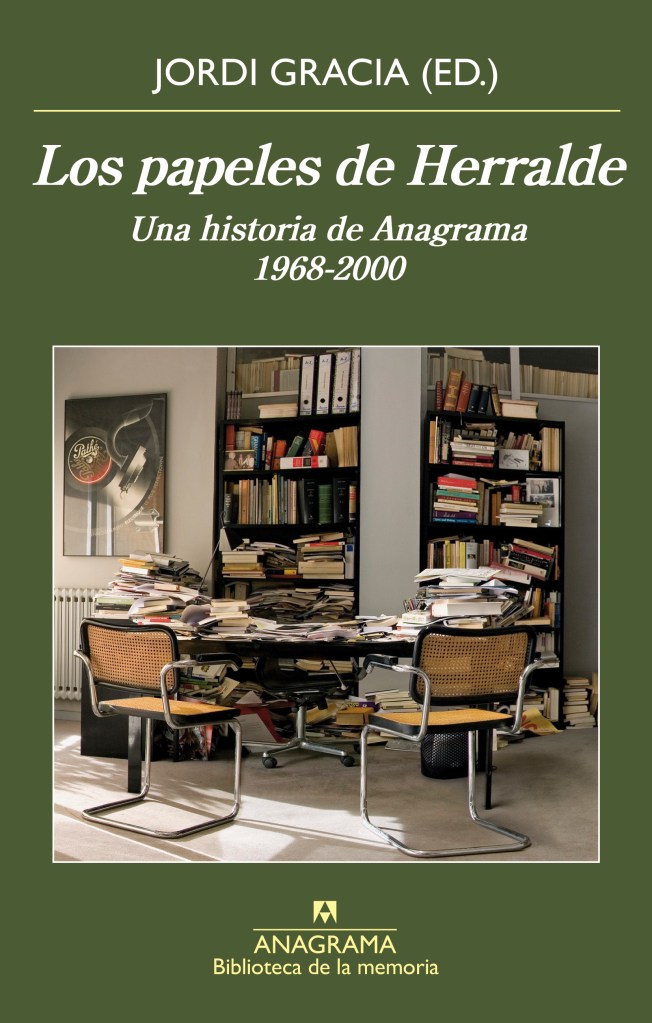
    I took the book from the shelf and left it on the table for a few days. It is Los papeles de Herralde. It is the photo on the cover, not the content, the two chairs that contain a punctum for me in the picture. My family had these chairs before as a set, more than two, but the legs are black. I learnt later that they were called Cesca chairs, designed by Marcel Breuer. And the chairs, one by one, with the six-way hand-woven cane pattern, when the strands broke with age, the seats gradually sagged and tore apart into disuse, like how one takes note of friends who pass away in old age.

    The clutter on the table of Jorge Herralde, the renowned editor of Spanish-language literature, is more exaggerated than the clutter that my father would create in his living space, his office space. The year the chairs came was when we moved to a new place: 1986. My dad was only 36 years old. And now I, as a man of 46 (no longer a child), think of how my dad was managing then as a man at that age: his life, his work.

    The ups and downs of the years after 1985. I recall the rage he flew into, and the dollar notes, many of them, were flung into the air and descended like confetti. He is now 76 years old, and I think about the time when he was facing challenges at 36, when I was 7. It is not the numbers that matter, but they remain indications of me as a silent witness of the scene, framed by the doorway, and of the thought that I might, by chance, pick up one loose note, the larger denominations able to buy something. And if I were to tell him now about the incident, he would say he doesn’t remember, as if I were making, like the police, a new accusation. And I myself would say that I know nothing about what Seneca or Spinoza taught about anger, about consequences, or about impartial knowledge.

    Every time I see in movies heroic robbers throwing money out of a window for the crowd below rather than for the authorities to reclaim, or those sums that fill suitcases or duffel bags, or when I read the sublime scene of burning money thrown out of a window described by Ricardo Piglia in Money to Burn, I recall the scene I witnessed in 1985. And when I see the Taoist practice of burning joss paper, folded into the shape of ingots, meant to represent money for the dead, I think again about the scene in Piglia’s novel. There we see madness—madness that could be rage, or irrationality, or both, but never the absence of both. There we see not the gradual wearing of rattan vine as it breaks apart with time, but simply money—perhaps representing abstract time itself—burning. Below is a long citation of Piglia’s text (Money to Burn, pp.159-160, 2003 [1988]):

    “The notion also began to circulate that the burnt money served as an example of murderous madness. Only crazed killers and immoral beasts could be sufficiently cynical to burn 500,000 dollars. Such an act (the dailies said) was worse than all the crimes that they had committed, because it was an act of nihilism and an example of pure terrorism.

    In statements made to the magazine Marcha, the Uruguayan philosopher Washington Andrada signalled that however terrible one might consider it, such an action, a kind of innocent potlatch let loose on a society with no memory of such a ritual, an act absolute and free in itself, a gesture of sheer waste and sheer outpouring, would in other societies have been taken as a sacrifice made to the gods because only the most valiant is worthy of sacrifice and there is nothing more valiant between ourselves than money, so said Professor 

    Andrada, and he was at once summoned by the magistrate.

    The manner in which they burnt the money is proof absolute of their evil genius, because they burnt the money by rendering clearly visible the bills of 1,000 pesos which gradually took light, one after the next, the 1,000-peso bills burned like butterflies whose wings are touched by the flames of a candle and beat for another second as they flare, flying on through the air though consumed by fire for an interminable instant before burning out and turning to ash.

    And after all these interminable minutes in which they say the notes burnt like flaming birds before transforming into a heap of charcoal, a funeral pyre to our social values (as declared an eye-witness on television), a wonderfully beautiful column of azure ash raining from the window in a shower resembling the calcified remains of the dead that get scattered across the ocean, or over the mountains and woods, only not over the filthy city streets, for ash must never drift on to the stone floor of our concrete jungles.”

  • Un Viejo Amigo

    por Justin Loke

    Empecé la mañana leyendo el capítulo 9 de Tomás Nevinson de Javier Marías y me llamó la atención su descripción de María Viana: los hoyuelos apenas perceptibles y la manera en que su mirada camina por la línea fina entre el asomo de un hombre libidinoso y el retrato elegante de la belleza de una persona. Espero que hoy el estudio y la lectura puedan compensar lo de ayer, que se perdió entre distracciones relacionadas con el “business” (asi “busy”) y el desgaste inevitable de la gestión de personas.

    Un viejo amigo de la escuela primaria me envió un vídeo en el que se improvisaba un motivo floral sobre un objeto, celebrando la habilidad y la espontaneidad del gesto, y afirmando que esa habilidad era un arte.. Estuve tentado de responder que se trataba de artesanía y no de lo que él llamaba arte, pero preferí callar, sabiendo que en otro contexto podría invocar esa misma artesanía como antídoto frente al charlatanismo de ciertos artistas conceptuales, y quizá incluso reivindicarla, no sin ironía, con respeto a William Morris.

    Pero ¿es acaso mayor insulto callar, porque supone ignorarlo, o decirlo con franqueza para mostrar hasta qué punto nuestros caminos se han separado, algo que ya hice antes, sabiendo además que él es más bien antiintelectual? Siento el impulso de escribirle sin rodeos: “esto es artesanía y no me interesan las artesanías, por si no lo sabías”, o bien responder de forma neutral: “Sí, hay mucha habilidad en ese tipo de hacer”. Algo parecido ocurre con su gusto musical y su admiración por los solos de guitarra líder de los años ochenta, que ya no me impresionan y que percibo como cosas propias de la adolescencia. ¿Es la sinceridad y la honestidad, incluso hacia un viejo amigo, algo que ahora viene acompañado de tanta vacilación? Tal vez la vacilación no indique falta de honestidad, sino la conciencia de que decir la verdad ya no produciría ningún encuentro.

  • Inaction: Reading Hadot on Plotinus in the First Hours of the Year

    By Justin Loke

    “When people are too weak for contemplation, they switch to action, which is a mere shadow of contemplation and of reason. Since, owing to the weakness of their souls, their faculty of contemplation is insufficient, they cannot grasp the object of their contemplation and be fulfilled by it. Yet they still want to see it; and so they switch to action, in order to see with their eyes what they could not see with their spirit. In any case, when they create something, it is because they themselves want to see it and to contemplate it; and when they propose to act, insofar as they are able, it is because they want their act to be perceived by others.” (III 8, 4, 33–39)

    This is not a review of the book, nor even a considered assessment of Pierre Hadot’s book on Plotinus as a whole, but merely a response to a segment I stumbled upon late last night, reading without urgency, in the first hours of the new year. It is a habit I seem to have acquired long after the drinking and parties of younger days fell away, and perhaps not entirely without precedent in older traditions, where the turning of the year called less for release than for attentiveness, for restraint in speech and gesture, for a certain care at the threshold, with 2026 already vaguely in mind as the year in which I am meant to be finishing other, heavier things.1

    Plotinus writes with a severity that is so uncompromising it sometimes becomes almost funny. When he claims that “when people are too weak for contemplation, they switch to action, which is a mere shadow of contemplation and of reason,” he reverses an entire moral economy at a stroke. Action is no longer strength, courage, or engagement, but impatience, a compensatory movement for a soul unable to remain with what it sees. We act, he says, because we cannot bear contemplation long enough to be fulfilled by it. Action becomes a kind of visual aid, a way of seeing with the eyes what could not be sustained by the spirit. Even creation, in this account, is not generosity or excess, but restlessness: we make things because we ourselves want to see them, and we act because we want our acts to be perceived by others.

    This is Platonism at its most extreme, pushed so far that it tips into inversion. Action is not condemned outright, but quietly degraded, reduced to a shadow cast by failed contemplation. One can almost hear the irony: the more urgent and energetic the action, the more it betrays spiritual weakness. It is not inaction that Plotinus praises, but a stillness so demanding that most souls flee from it. The rush to act becomes faintly comic, not immoral, just hurried, unable to endure the intensity of seeing without immediately externalizing it.

    The same logic reappears in his account of beauty. Plotinus insists that beauty does not reside primarily in symmetry or proportion, but in an added presence, “some kind of aura,” a light that shines upon form and animates it, luminous, though not quite equal to light itself.

    “Even in this world,” he writes, “we must say that beauty consists less in symmetry than in the light that shines upon the symmetry, and this light is what is desirable. After all, why is it that the splendor of beauty shines more brightly upon a living face while only a trace of beauty appears on the face of a dead man?… The living man, even if he is ugly, is more beautiful than the most beautiful statue, because life is better than stone. (VI &, 22, 24-32)”

    Here again, the claim is initially compelling. Pure proportion is not enough; something lifelessly perfect can fail to move us. But the final analogy falters. A living face compared to the same face dead is an easy case. It quietly replaces the harder aesthetic question (living face versus statue) with an ontological one. Life is smuggled in as a guarantee of beauty, and the hierarchy of being is allowed to decide what perception should conclude.

    I do not agree that an ugly living man is more beautiful than a great statue simply because he lives. A statue is not cold; it appears finished, but we know that for its maker it is always unfinished, or rather, it accepts its incompletion, abandoned by the artist in the way Giacometti leaves a figure unresolved, or the way Paul Valéry speaks of abandoning a poem rather than finishing it. It is a sentence with parts best left unsaid. As La Rochefoucauld reminds us, eloquence lies in knowing what not to say. It does not lack light; it refuses transcendence. What Plotinus distrusts, here as elsewhere, is anything that might rest in itself, anything that does not point upward or demand completion elsewhere. Life, movement, action, illumination, all are valued because they refuse closure. An ugly man, by contrast, is an actuality, the realization of a failed ideal, failing even to fulfill the idea of ugliness itself, something that being alive cannot compensate for.

    This is where Plotinus becomes most revealing. His philosophy is not wrong so much as excessive. It is so faithful to contemplation that it must demote action, so faithful to ascent that it must suspect form, so faithful to life that it must slight the completed object. The arguments are beautiful. One could admire the purity while smiling at Plotinus’s impatience in advocating contemplation and derogating action.

    1. It is worth recalling that the association of the New Year with excess (drinking, noise, release) could be relatively recent. In older ritual traditions, particularly within Confucian culture, the turning of the year was treated as a threshold rather than a rupture. One was careful with words, gestures, and conduct, as if the opening days set a tonal pattern for what followed. Feasting existed, but it was governed, not compensatory. The modern New Year, by contrast, bears the mark of fatigue: a sanctioned interval of excess that answers the pressures of work and accumulation. What now appears as celebration once functioned more as alignment. ↩︎
  • The Retreat of Reality: On Agamben’s What is Real? (2018)

    by Justin Loke

    For much of Western thought, reality was understood as something necessary, of necessity: things happened for reasons, and even if humans did not yet know those reasons, they were assumed to exist. This view goes back to Aristotle, who described reality in terms of potentiality (dynamis) and actuality (energeia). For Aristotle, potentiality was not just the chance that something might happen; it was a real capacity that also included the power not to happen. A seed could become a tree, but it could also remain a seed. Meaning arose from this relation between what can be and what need not be. Agamben’s core idea of potentiality is not the same as probability. Potentiality means a real capacity that also includes the power not to pass into action (can be / can not be). Probability, by contrast, is a measured likelihood inside a system designed to predict and produce outcomes. So probability is a tool of operativity; potentiality is a deeper openness that resists being reduced to outcomes.

    Modern science originally shared this belief in necessity. Its task was to discover the laws that made events inevitable. Quantum physics, however, breaks this picture. At the atomic level, scientists can no longer say what is happening, only what is likely to happen. For example, you cannot know both an electron’s exact position and its exact motion. Scientists no longer say “the electron is here,” but “the electron is likely to be here.” Nature itself does not allow such certainty. Based on the uncertainty principle: reality cannot be fully known as determinate. Instead of necessity, science works with probability. At this scale, particles no longer appear as definite objects but as statistical distributions, described not by what is but by what may occur.

    This shift does not weaken science; it strengthens it. Even if individual events are uncertain, large numbers allow outcomes to be engineered with remarkable reliability. Modern technologies, from nuclear power to nuclear weapons, depend on this logic. Reality retreats, but control increases. Science no longer reveals truth in the classical sense; it manages uncertainty.

    Ettore Majorana, the physicist at the centre of Agamben’s What Is Real?, grasped this problem with unusual clarity. He argued that probability was not merely a limit of human knowledge but a feature of reality itself. If the world is fundamentally probabilistic, the scientist no longer stands as a witness to truth, but becomes a technician of models. Agamben reads Majorana’s mysterious disappearance not as an accident or suicide, but as a symbolic gesture: the subject of science disappears along with reality.

    Simone Weil sharply criticizes this transformation. She observes that science has abandoned the search for necessity, which once gave meaning to the world (the sense of “it must be so,” which gives meaning). Modern science explains how often things happen, not why they must happen. It becomes effective but spiritually empty. For Weil, when necessity disappears, meaning disappears with it.1

    To reiterate, probability is not the same as potentiality. Probability is calculated, measured, and used to produce outcomes; it belongs to systems of prediction and governance. Potentiality, by contrast, includes the capacity not to act, not to pass into actuality. For Agamben, a proper life lies in potentiality, not in probability. So what do we mean by “real” now: reality is no longer something stable and necessary that truth reveals; it becomes something managed through statistical prediction.

    This led me to think about how Borges shows that worlds can be “real” because a system, such as an encyclopedia, a language, a model, takes hold and organizes life, fiction becoming reality. In stories such as Tlön, Uqbar, Orbis Tertius, a fictional system becomes real because people begin to be enveloped by it. An invented encyclopedia begins to determine how people think, speak, and study, until its fictional world becomes more operative than the one it displaced..2

    What seems important here is the difference between fiction becoming reality and the idea, often stated cynically, that reality itself has become fiction. The latter expresses a kind of resignation: that nothing is true anymore, that everything is just narrative, and that belief no longer matters. It dissolves responsibility by flattening truth and fiction into the same indifference.

    What Borges points to is something more precise and more troubling. Fiction does not replace reality, nor does it expose reality as mere illusion. Rather, constructed systems gradually take on the weight of reality because they are used, inhabited, and relied upon. Reality is not negated but produced: worlds come into being not through truth, but through their capacity to organize life.

    When people say “reality is fiction,” they usually mean it in a cynical way. It suggests giving up: that nothing is really true anymore, that everything is just spin, stories, or opinions, and that believing in anything is pointless. It treats the world as fake and assumes there’s no reason to take truth or responsibility seriously.

    “Fiction becoming reality” means something else entirely. It doesn’t say the world is fake. It says that ideas, models, and stories can slowly start to shape how people live, until they function as reality. A system may begin as an invention or theory, but once people rely on it, organize their lives around it, and act as if it were real, it becomes real in practice. The danger here isn’t illusion, but effectiveness: things gain power not because they are true, but because they work and are widely used. We can start thinking the “real” is produced and maintained.3

    Is Agamben warning us that modern reality increasingly functions in this way, constructed like fiction, yet enforced as truth? It is assembled from models, probabilities, and scenarios, structures that resemble fiction in their construction but are enforced as unquestionable reality. This is not a claim that nothing is real. It is a more uncomfortable insight: that reality today is often something made, stabilized, and governed, and that the task is not to deny it, but to learn how to live within it without being entirely absorbed by it.

    The world is not fake; it is being shaped by what people use and believe to be true. And truth (before we draw distinctions between the true and the real, often assumed to be synonymous) has always been constructed through language. We describe and name the world through words from the very beginning; we have never encountered it without them. What has changed is not that reality has disappeared, but that its construction has become increasingly technical, probabilistic, and governed. The task, then, is not to retreat into cynicism, but to remain attentive to how reality is made, and to how one might live within it without surrendering entirely to its mechanisms.

    1. Sur la science, Simone Weil, Gallimard, 1966 ↩︎
    2. “Desde el fondo remoto del corredor, el espejo nos acechaba. Descubrimos (en la alta noche ese descubrimiento es inevitable) que los espejos tienen algo monstruoso. Entonces Bioy Casares recordó que uno de los heresiarcas de Uqbar había declarado que los espejos y la cópula son abominables, porque multiplican el número de los hombres. Le pregunté el origen de esa memorable sentencia y me contestó que The Anglo-American Cyclopaedia la registraba, en su artículo sobre Uqbar. La quinta (que habíamos alquilado amueblada) poseía un ejemplar de esa obra. En las últimas páginas del volumen XLVI dimos con un artículo sobre Upsala; en las primeras del XLVII, con uno sobre Ural-Altaic Languages, pero ni una palabra sobre Uqbar. Bioy, un poco azorado, interrogó los tomos del índice. Agotó en vano todas las lecciones imaginables: Ukbar, Ucbar, Ookbar, Oukbahr… Antes de irse, me dijo que era una región del Irak o del Asia Menor. Confieso que asentí con alguna incomodidad. Conjeturé que ese país indocumentado y ese heresiarca anónimo eran una ficción improvisada por la modestia de Bioy para justificar una frase. El examen estéril de uno de los atlas de Justus Perthes fortaleció mi duda.” Tlön, Uqbar, Orbis Tertius, 1940 ↩︎
    3. I began to think about money, about currencies, as a promise, and about the creation of debt. Money is not powerful because it is true, but because it works. A banknote, a digital entry, a currency has no intrinsic reality beyond the system that sustains it. It is a promise, backed not by substance but by collective belief, institutional enforcement, and habitual use. Money becomes real because it circulates, because it is accepted, because lives are organized around it. Its power lies not in truth, but in effectiveness. Currency is therefore one of the clearest examples of fiction becoming reality. ↩︎

  • “Diagram of an alleged oubliette found in the Bastille prison in Paris, from Viollet-le-Duc (1854–1868) the commentary speculates that the structure depicted, may actually have been an ice well built to keep ice. If so, whether or not it was known to also have been used as an oubliette is not clear” 1.

    “ […] A medieval glossary explains the meaning of the neologism dementicare, which was beginning to substitute the more literary oblivisci in common usage, as follows: dementicatis: oblivioni traditdistis. The forgotten is not simply cancelled or left aside: it is handed over to oblivion. The pattern of this unformulable tradition was set out by Hölderlin in his notes to the translation of Sophocles’ Oedipus where he writes that God and man, ‘in order that the memory of the heavenly ones not vanish, communicate in the form, all-oblivious, of infidelity.2

    “Fidelity to that which cannot be thematized, nor simply passed over in silence, is a betrayal of a sacred kind, in which memory, spinning suddenly like a whirlwind, uncovers the hoary forehead of oblivion. In this attitude, this reverse embrace of memory and forgetting that holds intact the identity of the unrecalled and the unforgettable, is vocation.” – The Idea of Prose, p.45

    An oubliette is a specific kind of dungeon: a small, often bottle-shaped room accessible only through a trapdoor in the ceiling, built so that a prisoner could be forgotten. The word comes from the French oublier, “to forget.” An oubliette is thus not merely a chamber beneath a trapdoor but the architecture of forgetting itself, a place where one is locked, and drift quietly towards oblivion, the same Indo-European root that gives us oblivisci, to slip from memory, and dementicare, to un-mind, to release something from the charge of recalling. Dementicare (perhaps like dementia) is not just to forget, not a careless loss, but to hand-over to oblivion. All three terms cluster around the semantic field of forgetting.

    From the text above, on the sense of vocation, it is where the call is inseparable from the possibility of its own suspension: the person in the oubliette inhabits the moment when one’s name, task, or summoned purpose hovers between being remembered and being released from it, neither renounced nor fulfilled, simply waiting in the dim interval where abandonment and destiny briefly coincide. Perhaps the task of a poet or an artist is not to declare truths, not to recite doctrines, and all the more not to be soaked in activism now, or to share a personal trauma explicitly, to lament marginality, or to act as the great moralist on social media. It is not to fix memory, or to flirt with the posture of an archivist while lacking the dedication and obsession of a true archivist.

    It is to bear witness, to bear witness to what can neither be fully remembered nor truly forgotten. The poet is not faithful to the content of memory but to the tense movement between presence and absence, between remembering and forgetting, holding the unsaid together with the unforgettable. Yet perhaps the only true witness is the dead witness.

    “To what is the poet faithful? What is the question here is something that cannot be fixed in a proposition or memorised as an article of faith. But how can a vow be kept if it is never formulated, not even to oneself? It would have to quit the mind n the very moment it affirms its presence there. […]”

    1. https://en.wikipedia.org/wiki/Dungeon ↩︎
    2. Is he saying that memory is preserved through a kind of forgetting, and that the relationship between gods and humans is sustained not by perfect fidelity but by a necessary, paradoxical “infidelity.”? ↩︎