La Arena
by Justin Loke
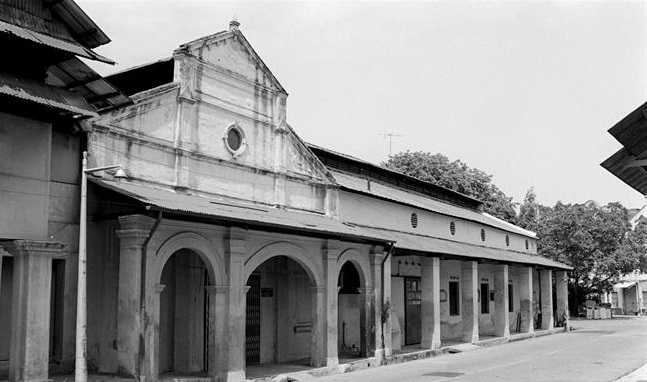
Ng Sua Ping, a Teochew Singaporean, grew up in the Robertson Quay area, also known as Au Pa Yoh, or Chwee Long Lai. He didn’t complete secondary school and was orphaned at eighteen. As a child, he had once unwittingly warned a young British soldier at Bugis Street night market about a pickpocket. Grateful, the soldier befriended him and showed him painted postcards of landscapes. “I’m Scottish, not English,” he liked to say, and told Ping he was applying to art school back in the UK. He lived in the single-men’s quarters within the Beach Road Police Station compound, a barracks shared by unmarried and married men, with dorm rooms, communal mess halls, and recreation spaces. Ping remembered entering it once, led by the soldier, and seeing how the men lived. From the third storey of the barracks, he looked out toward the sea and the beach. As he watched the waves recede and rush back against the sand along the coast, a picture formed in his mind, an idea stirring quietly within him.
Inspired by the painted postcards shown to him by the soldier, Ping began to paint beaches, scenes that were timeless, placeless, ahistorical, almost imagined tropical paradises, copied from magazine clippings and second-hand travel books. He sold them to an Indian shop near the General Post Office, in the tourist district, turning it into a modest source of additional income.
Twice he applied to the Nanyang Academy of Fine Arts but failed the entrance exams. He remembered the man who gave feedback, an administrator or teacher, holding a cigarette, saying he needed more practice before reapplying. Ping felt his eyes burn when he heard it the second time; he wasn’t sure if it was the smoke or the sting of rejection. He noticed the students who passed through the school’s entrance wore better shoes and spoke with confidence. They came, he thought, from better backgrounds. He wasn’t sure he would fit in.
In the 1960s, he often loafed along Robertson Quay with a group of friends. Once, when a Punjabi guard had dozed off, they snuck into a warehouse near the now-erased Pukat Road, just off Martin Road. It had once been a glass factory, the floor still glittered with fragments that resembled tiny shards of ice and powdery frost, the kind that would never melt in tropical heat. He wondered why glass, whole, remained clear, yet turned frosted and opaque when broken.
Despite the glass scattered across the floor, the warehouse was filled with sandbags. It was said that these sandbags had been packed into containers and sent to U.S. troops in the Vietnam War. The bags were made of coarse burlap, rough to the touch, stitched like hastily patched skin. The sand inside held firm, refusing to slip away; his friend said they could be used as punching bags. But one sack had a hole. He dug his finger into it and felt the coarse density, slightly damp, stubborn, unshifting.
In the early 1970s, Ping left Singapore to work for his Thai-Chinese uncle in Pattaya, who ran a modest hotel and, quietly, worked as a pimp. His uncle liked to say that Pattaya had been a sleepy fishing village before the American soldiers came. Ping thought of how people said the same about Singapore – that before Raffles, it too was a sleepy village. Everywhere, it seemed, was sleepy before the Europeans arrived, he mused. The sex tourism trade here, his uncle said, wasn’t born of tradition, it was invented to solve the economic problems of a feudal, stratified society. His uncle also sold postcards of beaches, though now they were photographs, not paintings.
One evening on the beach, Ping walked barefoot, feeling the sand between his toes. He grabbed a fistful. Pale, soft, almost powdery, and let it sift through his fingers, like time like he could not hold. He thought of the sand in the warehouse years ago, coarse and tamped down. In a world unraveling, those bags had held their shape.
He remembered once being told to clean up a room vacated by a U.S. soldier, someone who had left, or perhaps disappeared, without paying. Disappeared, it seemed, because all his belongings were still there. As Ping rummaged through the room, hoping to find cash or something of value, he pushed in his whole hand into a duffel bag. At the bottom, he felt a trace of sand. It was coarse, just like the sand from the warehouse at Pukat Road.
He also found a strange book. On the spine: Holy Writ. Bombay. Inside, the pages were worn and cramped, printed in double columns like a Bible. But the numbers were odd: page 50,908, followed by 999, then an eight-digit figure. There were small drawings too: a helmet, a strange fish, inked in the clumsy hand of a child. He closed the book. Later, he threw it away with the rest of the items.
When his unmarried uncle died, Ping continued running the hotel. His Thai became fluent. He married a local woman and had four children. After the war, the clientele changed: the soldiers were succeeded by an invasion of tourists. Pattaya carried on a young legacy of desire and transaction.
“An arena where war and leisure blurred. It was both missile trails and fireworks in the night sky. Play and violence, festival and war, in the anthropological sense, were not opposites but excesses of the same human impulse. In ancient Rome, the arena was the central pit of an amphitheatre, its sand meant to soak up blood from combat. Over time, the word came to mean the whole place of spectacle, not just the sanded floor.” This is was what a tourist from Spain once told him, or at least, he recalled it as such. The man had said that in Spanish, la arena means “sand.”
From then on, the word held both meanings for Ping: not just the beaches and wave pictures, but the battlefield too. Many years later, back in Singapore, he was walking along the Kallang River during National Day celebrations when he saw fireworks in the night sky, he related it to the roar of fighter jets earlier. He thought of the word again, and of the type of sand he had once felt.
Image Credit: National Library Board Singapore
 illiteratus.com
Leave a comment