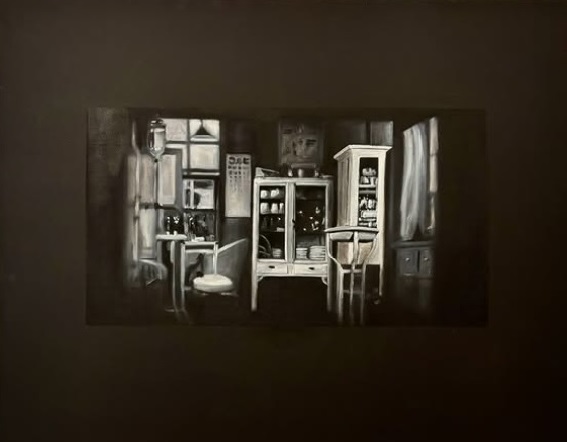
You were very sick during that year. Bedridden in the hospital, unable to walk, you lay staring at the black TV screen in the room. The TV was off. The flat screen, slightly tilted, on the wall like a painting not properly hung.
The book you had with you contained an essay titled Discovery of Landscape by Kojin Karatani. It was half-read. As you stared at the black screen, you realized that Malevich’s Black Square paintings were prophecies of the future: televisions, computer monitors, and phone screens. The faint reflection of the room on the blank screen of the silent television became a subtle, abstract landscape. You didn’t care about the valid or correct art historical interpretation of black squares, but at that moment, that was how you saw it.
Apart from the black screen, which in this case was more of a black rectangle, you lay in bed and stared out of the window. The sense of time could be traced only through the changes in the sky, light to dark, dark to light, and the sounds of the hospital staff pushing carts and trolleys, the clatter of dishes as others were served before you, the soft footsteps interrupted at regular intervals by the nurse checking blood pressure, temperature, and so on, and occasionally a doctor who walked in to show care.
The grey at times could turn blue, or a faint false English grey. It was near the end of the year, and how nice it would have been to be out, to enjoy the breeze and those skies that last only a few months here. You had read somewhere a description of an immobile patient who could see the time and days pass only through the shape of the frame of the window. You cannot recall which book it was, or perhaps both you had read then had something about this experience, of coming out of illness, of the long suspension of days.
It also brought back a memory of a visitor, though you are less and less certain now if it really happened or was only a dream or imagination. You were heavily medicated then.
When you woke up, he was sitting at the edge of the bed, staring at you. Then you must have dozed off again, because later you saw him again, this time on a chair next to the bed. There was only one chair, perhaps borrowed from another bedside. On the movable table, you noticed a plastic bag. Inside it was a bunch of bananas, yellow of course, with brown spots that reminded you of the long necks of giraffes in children’s illustrations.
He was a visitor, a friend who had turned himself into one, but not the relative who strides into a hospital room with practiced cheer, greeting other patients in their robes, dropping a bag of snacks and fruit on the nightstand, occupying the small surface area with things you did not want. He was quieter. He sat and stared at you. At times, when you recall it, it is as if he was feeling the pain and suffering more than you. And during those days when you used to work together, such a description would have been something to laugh about.
Later, when you met him again, he said that your face then had been ash coloured, or ashen, or the colour of ash. When he could have used the word pale. You had spoken, or kept silence, for maybe half an hour, and then, as though a bell had gone off, he stood up and left, as though he had never been there, leaving you to gaze into the eyes of the paralyzed patient across the ward struggling to breathe. Then you remembered, he had come with his wife. It was a somber, quiet visit. Not many came, because not many you had told, because not many cared. Those who visited perhaps are the few who would attend your funeral.
This visit means nothing. It was a visit, simply that, one person visiting another. Yet the more you thought about it, the less certain you became who had been the visitor, and who the visited. Who is the visitor, and who the patient.
There is a passage somewhere, you do not recall exactly where, about a kind of action where the one who acts and the one who is acted upon are no longer distinct. Perhaps that was what it was. When he came and sat there, when you looked back at him through the half-light, it felt as if you were each visiting yourselves through the other. The room became a single body that held both of you in it, one sitting, one lying down, reflecting the other’s stillness, reflecting the other’s illness. But it was your relation with him that had been very ill.
You think about the difference between seeing a patient in a hospital and seeing an art object on display, a sculpture or installation in a museum or a gallery. Some people will apologise out of politeness for not visiting your exhibition as well as your stay in the hospital. You could not walk then, but you remember thinking that walking must be something like that too, to give oneself over to the movement, to be carried by it rather than to control it. A kind of slow visitation between the body and the ground. To walk is an action upon oneself, not upon any external object by force or command. And it was precisely this relation with self and others that had fractured, that was malfunctioning.
So the self commanding the body — if to make this distinction or indistinction could be the soul — but to talk about the soul now is always inevitably sounding like a failed attempt to preach.
Lying there, the black television screen beside you, often to see was to be seen. The body, the bed, the chair, all were caught in the same quiet use. You read about what agent and patient used to signify.
When you were well again and took your first steps outside, you realized that you were still in that same relation, each step a return to yourself. To move was not to leave, and further the indistinction, where walking was another way of lying still. The illness is not a metaphor but an allegory of a relationship with yourself.
Who was the agent, who was the patient? It was surely the misconstrued idea of passion as active, when it is, like root of all vices, that made you passive.
Years later, when watching an old Japanese film by Ozu, there was a scene of an empty clinic. It reminded you of the black square and the smell of the hospital. With the white borders, Malevich painted a black square for us to stare into the black opaque abyss. The black square, a blind window, is now inverted, an appropriated image bordered and framed by black instead.
‘In another man devoured, my own death I do not see, with fever and geometry, I wasted the hours away, and now they keep vigil for me.’
 illiteratus.com
Leave a comment