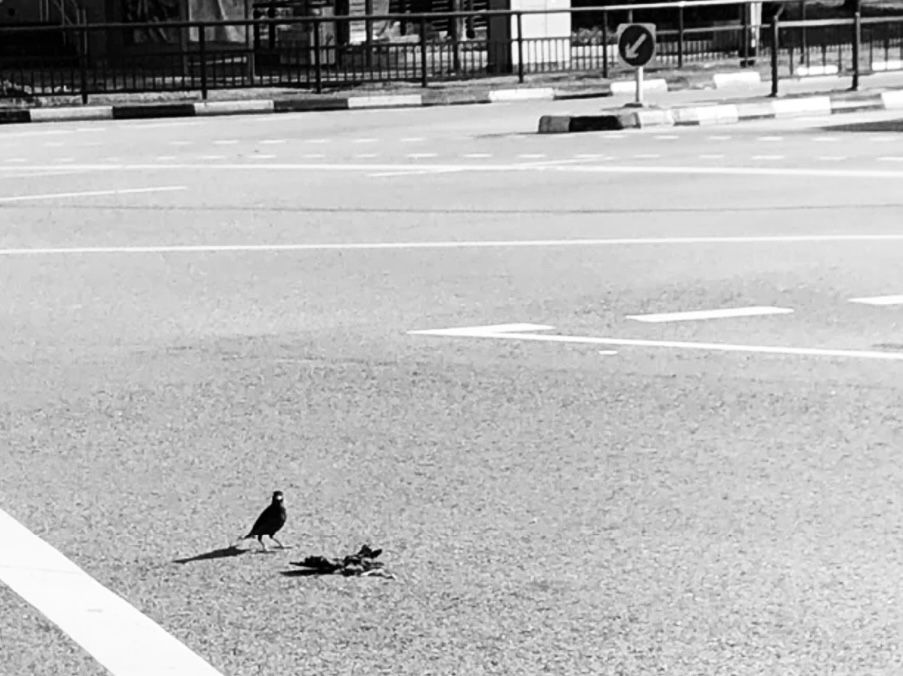
I often see roadkill on the streets of Singapore, small animals, mostly birds, often pigeons or Javan myna. They’re not just struck dead, but slowly obliterated by the endless stream of cars, until all that remains is a dark, indistinct smear on the asphalt. As a child, I was once told there’s a superstition about such sightings that when you pass by roadkill, you must spit, or at least brush the top of your head with your hand, to ward off bad luck. I find myself thinking of George Bataille’s idea of the formless (informe), that image of a “crushed spider or a glob of spit,” formlessness as rebellion against “the mathematical frock coat of ordered thought.”
Just as this passed through my mind, I noticed a pigeon on the right lane, not standing, not walking, simply crouched low. Flattened in posture, breast pressed against the road, as if brooding over a nest that wasn’t there. Or perhaps, this is how old pigeons choose to die. As if this lane, this strip of asphalt, were a designated space for avian suicide. An Anna Karenina moment, only it’s not a railway, but a three-lane road.
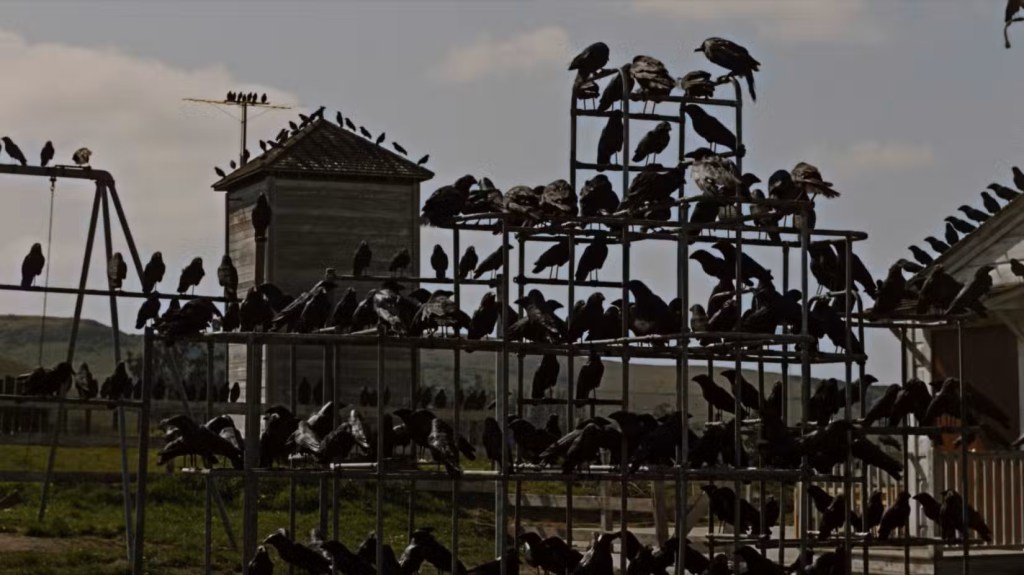
For a second, it felt Hitchcockian, but reversed. Not birds attacking humans, but birds surrendering to motorways and death. An unreal procession, a secret rite. Old pigeons lining the road not in flight, but in stillness, waiting not for crumbs, but for wheels. The horror is no longer how the birds might harm us, as in the movie The Birds, but how we could be reminded of unavoidable death.
In this imagined scene, the road stretches ahead, dotted as far as the eye can see with birds flattened, their bodies fused into the asphalt like faded stains. The surface is speckled with pale grey against a stretch of dark grey. Feathers, soft pink smears, and dark rust-red crusts lie dried and flattened across the road. A length of asphalt stippled with the light remains of creatures that once flew. I found myself guessing how many days it had been there, when one could just as easily wonder about the time that remains, the compression of meaning into the present moment.
 illiteratus.com
Leave a comment