“ […] A medieval glossary explains the meaning of the neologism dementicare, which was beginning to substitute the more literary oblivisci in common usage, as follows: dementicatis: oblivioni traditdistis. The forgotten is not simply cancelled or left aside: it is handed over to oblivion. The pattern of this unformulable tradition was set out by Hölderlin in his notes to the translation of Sophocles’ Oedipus where he writes that God and man, ‘in order that the memory of the heavenly ones not vanish, communicate in the form, all-oblivious, of infidelity.2
“Fidelity to that which cannot be thematized, nor simply passed over in silence, is a betrayal of a sacred kind, in which memory, spinning suddenly like a whirlwind, uncovers the hoary forehead of oblivion. In this attitude, this reverse embrace of memory and forgetting that holds intact the identity of the unrecalled and the unforgettable, is vocation.” – The Idea of Prose, p.45
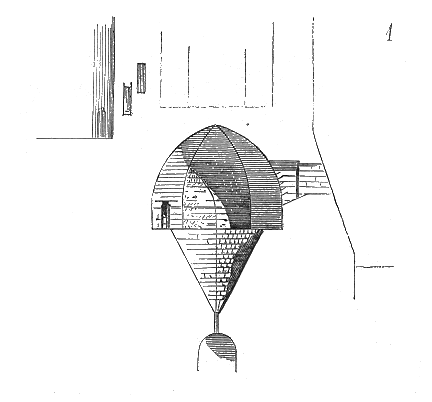
An oubliette is a specific kind of dungeon: a small, often bottle-shaped room accessible only through a trapdoor in the ceiling, built so that a prisoner could be forgotten. The word comes from the French oublier, “to forget.” An oubliette is thus not merely a chamber beneath a trapdoor but the architecture of forgetting itself, a place where one is locked, and drift quietly towards oblivion, the same Indo-European root that gives us oblivisci, to slip from memory, and dementicare, to un-mind, to release something from the charge of recalling. Dementicare (perhaps like dementia) is not just to forget, not a careless loss, but to hand-over to oblivion. All three terms cluster around the semantic field of forgetting.
From the text above, on the sense of vocation, it is where the call is inseparable from the possibility of its own suspension: the person in the oubliette inhabits the moment when one’s name, task, or summoned purpose hovers between being remembered and being released from it, neither renounced nor fulfilled, simply waiting in the dim interval where abandonment and destiny briefly coincide. Perhaps the task of a poet or an artist is not to declare truths, not to recite doctrines, and all the more not to be soaked in activism now, or to share a personal trauma explicitly, to lament marginality, or to act as the great moralist on social media. It is not to fix memory, or to flirt with the posture of an archivist while lacking the dedication and obsession of a true archivist.
It is to bear witness, to bear witness to what can neither be fully remembered nor truly forgotten. The poet is not faithful to the content of memory but to the tense movement between presence and absence, between remembering and forgetting, holding the unsaid together with the unforgettable. Yet perhaps the only true witness is the dead witness.
“To what is the poet faithful? What is the question here is something that cannot be fixed in a proposition or memorised as an article of faith. But how can a vow be kept if it is never formulated, not even to oneself? It would have to quit the mind n the very moment it affirms its presence there. […]”
- https://en.wikipedia.org/wiki/Dungeon ↩︎
- Is he saying that memory is preserved through a kind of forgetting, and that the relationship between gods and humans is sustained not by perfect fidelity but by a necessary, paradoxical “infidelity.”? ↩︎
 illiteratus.com

Leave a comment