You were very sick during that year. Bedridden in the hospital, unable to walk, you lay staring at the black TV screen in the room. The TV was off. The flat screen, slightly tilted, on the wall like a painting not properly hung.
The book you had with you contained an essay titled Discovery of Landscape by Kojin Karatani. It was half-read. As you stared at the black screen, you realized that Malevich’s Black Square paintings were prophecies of the future: televisions, computer monitors, and phone screens. The faint reflection of the room on the blank screen of the silent television became a subtle, abstract landscape. You didn’t care about the valid or correct art historical interpretation of black squares, but at that moment, that was how you saw it.
Apart from the black screen, which in this case was more of a black rectangle, you lay in bed and stared out of the window. The sense of time could be traced only through the changes in the sky, light to dark, dark to light, and the sounds of the hospital staff pushing carts and trolleys, the clatter of dishes as others were served before you, the soft footsteps interrupted at regular intervals by the nurse checking blood pressure, temperature, and so on, and occasionally a doctor who walked in to show care.
The grey at times could turn blue, or a faint false English grey. It was near the end of the year, and how nice it would have been to be out, to enjoy the breeze and those skies that last only a few months here. You had read somewhere a description of an immobile patient who could see the time and days pass only through the shape of the frame of the window. You cannot recall which book it was, or perhaps both you had read then had something about this experience, of coming out of illness, of the long suspension of days.
It also brought back a memory of a visitor, though you are less and less certain now if it really happened or was only a dream or imagination. You were heavily medicated then.
When you woke up, he was sitting at the edge of the bed, staring at you. Then you must have dozed off again, because later you saw him again, this time on a chair next to the bed. There was only one chair, perhaps borrowed from another bedside. On the movable table, you noticed a plastic bag. Inside it was a bunch of bananas, yellow of course, with brown spots that reminded you of the long necks of giraffes in children’s illustrations.
He was a visitor, a friend who had turned himself into one, but not the relative who strides into a hospital room with practiced cheer, greeting other patients in their robes, dropping a bag of snacks and fruit on the nightstand, occupying the small surface area with things you did not want. He was quieter. He sat and stared at you. At times, when you recall it, it is as if he was feeling the pain and suffering more than you. And during those days when you used to work together, such a description would have been something to laugh about.
Later, when you met him again, he said that your face then had been ash coloured, or ashen, or the colour of ash. When he could have used the word pale. You had spoken, or kept silence, for maybe half an hour, and then, as though a bell had gone off, he stood up and left, as though he had never been there, leaving you to gaze into the eyes of the paralyzed patient across the ward struggling to breathe. Then you remembered, he had come with his wife. It was a somber, quiet visit. Not many came, because not many you had told, because not many cared. Those who visited perhaps are the few who would attend your funeral.
This visit means nothing. It was a visit, simply that, one person visiting another. Yet the more you thought about it, the less certain you became who had been the visitor, and who the visited. Who is the visitor, and who the patient.
There is a passage somewhere, you do not recall exactly where, about a kind of action where the one who acts and the one who is acted upon are no longer distinct. Perhaps that was what it was. When he came and sat there, when you looked back at him through the half-light, it felt as if you were each visiting yourselves through the other. The room became a single body that held both of you in it, one sitting, one lying down, reflecting the other’s stillness, reflecting the other’s illness. But it was your relation with him that had been very ill.
You think about the difference between seeing a patient in a hospital and seeing an art object on display, a sculpture or installation in a museum or a gallery. Some people will apologise out of politeness for not visiting your exhibition as well as your stay in the hospital. You could not walk then, but you remember thinking that walking must be something like that too, to give oneself over to the movement, to be carried by it rather than to control it. A kind of slow visitation between the body and the ground. To walk is an action upon oneself, not upon any external object by force or command. And it was precisely this relation with self and others that had fractured, that was malfunctioning.
So the self commanding the body — if to make this distinction or indistinction could be the soul — but to talk about the soul now is always inevitably sounding like a failed attempt to preach.
Lying there, the black television screen beside you, often to see was to be seen. The body, the bed, the chair, all were caught in the same quiet use. You read about what agent and patient used to signify.
When you were well again and took your first steps outside, you realized that you were still in that same relation, each step a return to yourself. To move was not to leave, and further the indistinction, where walking was another way of lying still. The illness is not a metaphor but an allegory of a relationship with yourself.
Who was the agent, who was the patient? It was surely the misconstrued idea of passion as active, when it is, like root of all vices, that made you passive.
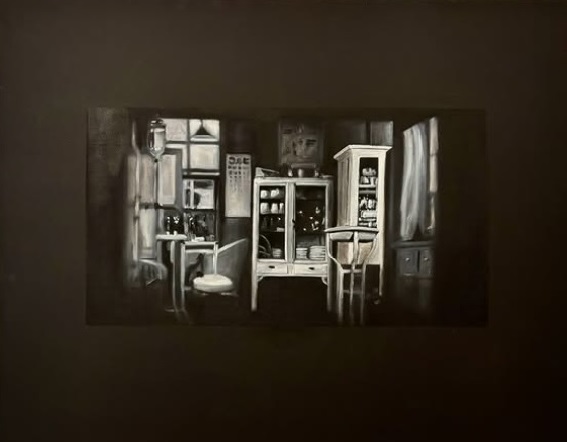
Years later, when watching an old Japanese film by Ozu, there was a scene of an empty clinic. It reminded you of the black square and the smell of the hospital. With the white borders, Malevich painted a black square for us to stare into the black opaque abyss. The black square, a blind window, is now inverted, an appropriated image bordered and framed by black instead.
‘In another man devoured, my own death I do not see, with fever and geometry, I wasted the hours away, and now they keep vigil for me.’
At first glance, Popeye the Sailor seems harmless: a comic celebration of spinach, a cartoon moral about the virtues of healthy eating. Yet beneath its slapstick repetitions lies a darker structure. Popeye is not simply nourished by spinach; he is dependent on it. He cannot triumph without the can. Read allegorically, Popeye becomes less a parable of nutrition than of addiction. The figure trapped in a cycle of reliance, and consumption, his identity bound to a consumerist substance that both saves and enslaves.
In Plato’s Pharmacy (in Dissemination), Jacques Derrida shows how the word pharmakon means both remedy and poison, cure and toxin. It is a concept that unsettles the very opposition between health and sickness. Spinach in Popeye’s world plays precisely this role. It does not simply nourish; it alters him instantly, like a drug that grants superhuman strength. Each episode replays the same ritual: Popeye falters, consumes, and triumphs. The spinach is his pharmakon. What rescues him, but also what chains him to dependency.
The Cycle of Dependency
This cycle mimics the addict’s experience. Popeye delays spinach until the moment of crisis, then surrenders to it as the only solution. His victories, though spectacular, are temporary, erased by the next episode, when the same craving will return. The narrative itself enforces the addiction: there is no Popeye story without the spinach scene. The cartoon, like the addict’s life, becomes structured by recurrence.
Walter Benjamin, in The Origin of German Tragic Drama, distinguishes between the symbol, which seeks wholeness, and allegory, which lives amid ruins. In allegory, objects point not to fullness but to absence, to what is broken or irretrievable. Is Popeye’s spinach can an allegorical emblem? Does it stand for the absent strength he cannot generate within? Each triumph is temporary, collapsing as soon as the credits roll. Popeye’s life is not progressive but cyclical, suspended in the eternal return of compulsive consumption.
The Consumer of Hope
The irony lies in the choice of spinach. Addiction is usually linked to vice such as alcohol, drugs, gambling. But spinach is the symbol of health, a staple of childhood obedience. By cloaking dependency in the guise of virtue, the cartoon anticipates how modern culture often disguises addiction under acceptable forms: casinos as “entertainment,” drinking as “bonding,” workaholism as “dedication,” and of course, the seemingly harmless lottery presents itself as salvation, as hope incarnate: for the price of a ticket, the poor man may dream of wealth, the weary worker of escape.
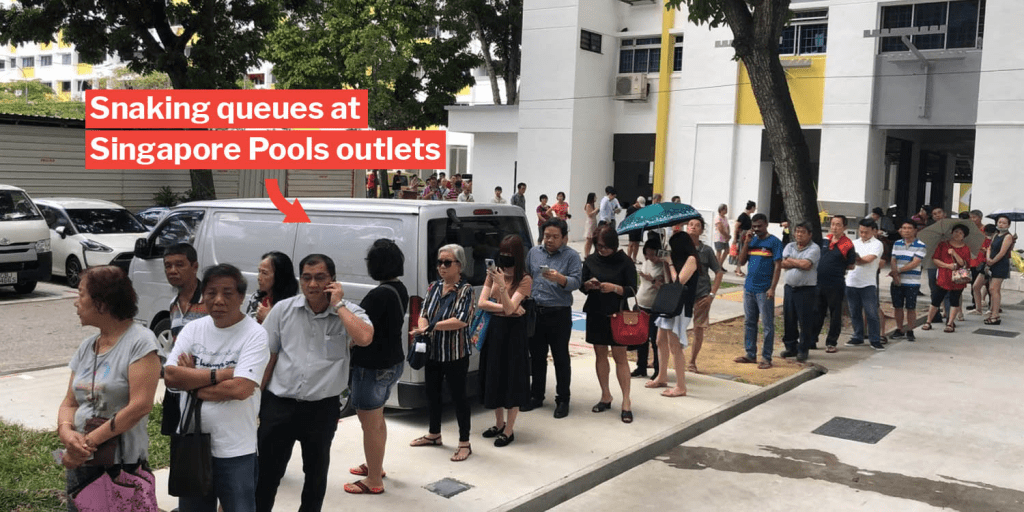
This marks the shift from the 19th century’s concern with depravity in the relations of production to the 20th century’s logic of consumerism, where alienation no longer stems only from labor and factory discipline but from cycles of consumption itself, of commodities, of images and desires on scoial media. What is consumed here is not merely a product, but hope, espera (waiting) and esperanza (expectation or hope), a secularized providence in which redemption is promised not by faith but by chance. Like Popeye’s spinach, the lottery is a pharmakon: it cures despair by offering fantasy, but poisons by entrenching the very conditions of desperation. The ticket, like the can, is allegorical. It is not a symbol of genuine salvation but a sign of absence, of the life deferred. Spinach, then, is the most insidious pharmakon because it is celebrated, while the lottery is a promise of redemption that perpetuates ruin. Hence, when there is huge snowball prize money of a huge amount in Singapore, we see a long queue similar to the soup kitchen in the West, or unemployed waiting for a job.
I was reminded of a lost photo, few year ago, before Milei became Pressident, a friend sent me, when visiting Argentina, photo of unemployed people queueing for a job in the morning. I was reminded of some of the scenarios depicted in Roberto Arlt’s Aguafuertes almost a century ago.
Popeye without spinach is still himself, but weaker, mocked, incomplete. With spinach, he is invincible, but only for a fleeting instant. His sense of self is chained to the can. Addiction works the same way: the substance fuses with identity, until one feels powerless without it. What appears as empowerment is in fact enslavement; what looks like choice is only repetition. Through this lens, the comedy of Popeye shades into tragedy. His victories are prefabricated, dependent on the ritualized fix. He is condemned to repeat: to falter, to consume, to triumph, to repeat again. The sailor, whose forearms bulge with strength, is at heart a fragile figure. His destiny is not freedom but compulsion, not growth but recurrence. Here, Popeye ceases to be a simple champion of vegetables. He becomes instead a figure of an allegory, his physical strength depending on spinach is the inversion of his soul in a vegetative state: a sailor forever denied freedom, caught in the loop of a dependency disguised as virtue.
Is the figure of the sailor, in seafaring narratives, not the final attempt at redemption in the history of the proletariat? The recurring gesture of those who, having squandered or broken their lives on land, fled to the sea? Sailors, in this sense, embody a flight from failure as much as a search for fortune.
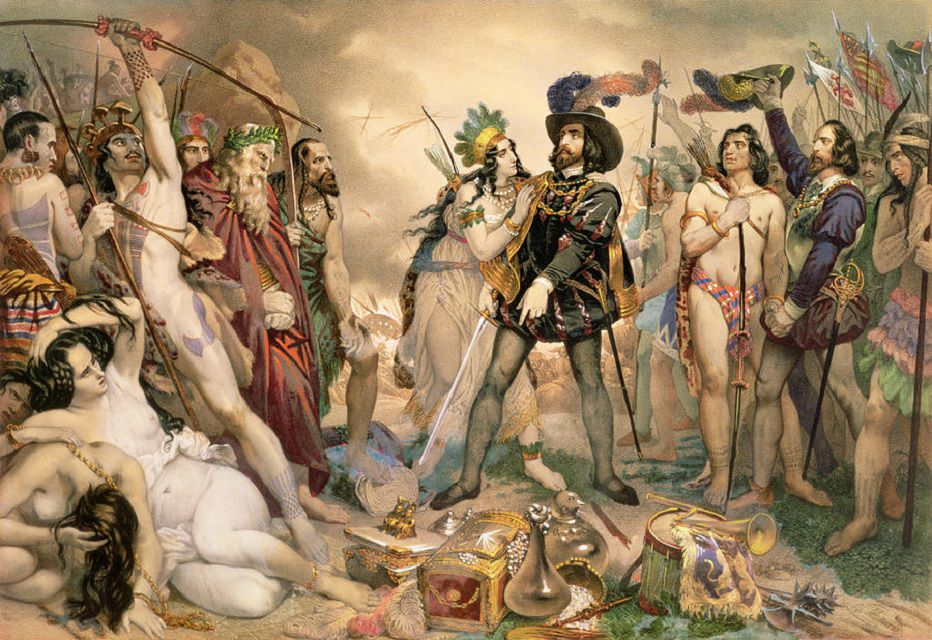
I once read that conquistadors like Hernán Cortés, too, sought in distance, via the sea, a redemption no longer possible at home. Many were in similar straits: lesser nobles, unemployed soldiers, or men crippled by personal debts. Exploration and conquest were imagined as a gamble for salvation, a wager to restore fortune and honor. To finance their participation, they borrowed, pawned possessions, or promised creditors a share of future plunder. Cortés, of course, was no worker but a younger son of a hidalgo family, from a region that produced many conquistadors. Without inherited land or wealth, and often entangled in debt, often for a variety of bad reasons, he sought both economic survival and social advancement by crossing the ocean.
In truth, these men were sailors by necessity and conquistadors only by contingency: it was the accident of finding treasure or other civilizations to plunder, the sudden license to kill and to conquer, that transformed them into figures of conquest for God, Glory, and Gold.
From Popeye, the sailorman with huge, disproportionately muscular forearms, his spinach-can inventory and strength, I started to digress, I thought of sailors in general, and of the salty breeze by the sea. The figure of the sailor an existential wager, a body fleeing the land it has exhausted.
I am reminded of Mallarmé’s Sea Breeze::
The flesh is sad, Alas! and I’ve read all the books.
Let’s go! Far off. Let’s go! I sense
That the birds, intoxicated, fly
Deep into unknown spume and sky!
Nothing – not even old gardens mirrored by eyes –
Can restrain this heart that drenches itself in the sea
O nights, or the abandoned light of my lamp,
On the void of paper, that whiteness defends,
No, not even the young woman feeding her child.
I shall go! Steamer, straining at your ropes
Lift your anchor towards an exotic rawness!
A Boredom, made desolate by cruel hope
Still believes in the last goodbye of handkerchiefs!
And perhaps the masts, inviting lightning,
Are those the gale bends over shipwrecks,
Lost, without masts, without masts, no fertile islands…
But, oh my heart, listen to the sailors’ chant!
(trans. A. S. Kline)
It is here where escape itself could be the cure, even if the cure is shipwreck. The sailor, like the gambler, consumes hope as his only commodity. Popeye’s spinach, the lottery ticket, the lifting ship anchor: each a different face of the same pharmakon, offering salvation through the possibility of ruin until one admits that no spinach, no lottery, no sea-voyage redeems, except the resurrection, the true Second Coming. It is not an issue of waiting or having hope, but of the means.
Perhaps it is not in all the men mentioned above that we find the right approach, but in a woman who knew how to wait: Simone Weil. In her French, attente means waiting in the deepest sense, a state of attention, receptivity, openness. It is not passive idleness but an active, watchful stillness. For Weil, attente de Dieu (waiting for God) is the stripping away of illusions and false consolations, holding oneself empty so that grace may arrive freely, without being forced.
At times, reading Walter Benjamin, or reading about him, brings me back to that afternoon when she was cooking in the kitchen. The copy I had was from the school library. I remember a renowned local art historian, during some gathering, dismissively calling the library collection “wretched,” unaware, perhaps, that John had asked the library to purchase a catalogue of books covering important titles in the critical theory lineage.
The paperback I borrowed, and renewed, was wrapped in a needless plastic sheet that had yellowed slightly with time. In Singapore, it’s common for schoolchildren to wrap their textbooks in transparent film – surely a decision made by their parents – and I remembered how, back then, seeing a classmate without that protective layer made their book seem almost barefoot, if not semi-naked. This copy felt much the same. Its corners were worn and peeling, and every time I turned a page or shifted my grip, the cover gave off a faint, brittle crackle, like cellophane forgotten too long on the shelf. Not to preserve value, really, but as a kind of premature preservation, sealing the book like a baby embalmed.
Later I discovered those librarians used other, even more atrocious methods of preservation. There were two other kinds of covers I recall: one was a soft plastic jacket that slipped over the book like a second skin, but was crudely, untidily held in place with scotch tape, leaving marks ; the other was adhesive – a kind of laminate applied directly to the cover, smooth but prone to air bubbles if done in haste, and once hardened, left the book cover rigid and unbending, like a paperback trying unconvincingly to pass as a hardcover.
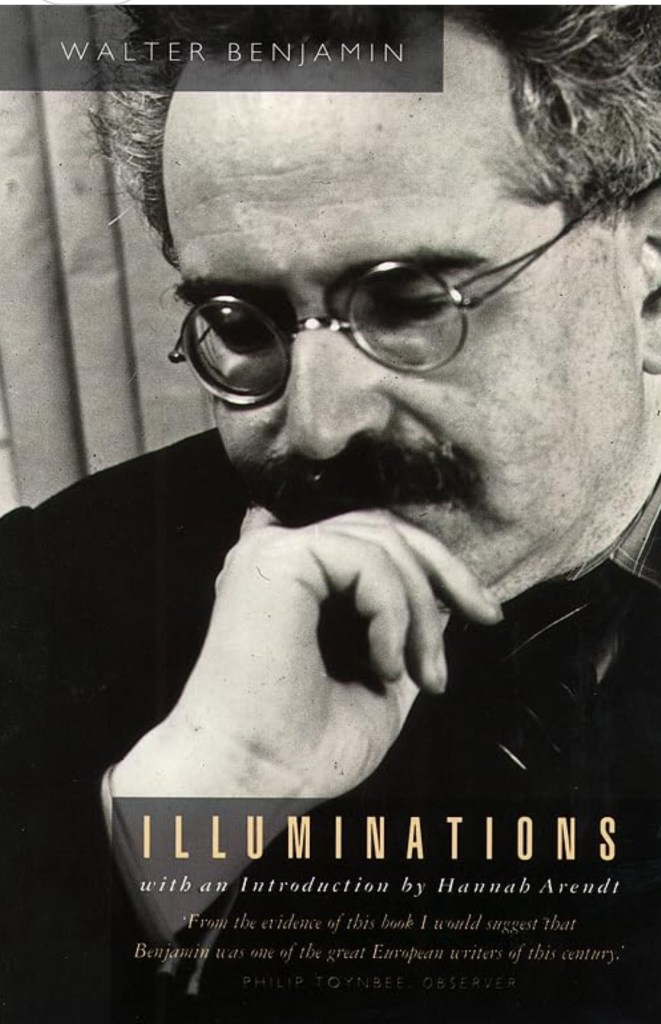
I think I was not even twenty-one then, and my language ability was nowhere near what it is now, at forty-five. The cover of Illuminations, the edition I held, had that familiar image of Benjamin ruminating, as though caught mid-thought. How much I understood of what I read is less important than the fact that I remember it still: the moment, the smell from the kitchen, the sense of something beyond my grasp but already part of me. I also remember the innocuous remark she made about me reading things beyond my abillity, but I’ve since realised that learning a language is not reading what is easy, but about following what draws you. That is the best motivation. It was for me then, and still is, as I’ve found again in learning Spanish and Chinese, and perhaps also in the disappointments of human relationships.
Snow Country (雪国, Yukiguni) 1957 directed by Shirō Toyoda
Not all mirrors are made of glass. But under certain lighting conditions, glass becomes a mirror. I am not thinking of convex or concave surfaces, of a distorted reflection on a spoon, a glass half-filled with water, or the sun glinting off the hood of a car, but only of flat panes that at night, with light behind them, turn reflective.
Yasunari Kawabata’s Snow Country begins promisingly with the girl on the train reflected in the glass, her face superimposed on the magnificient mountains and the landscape. I was so impressed that, after reading only a few pages, and not returning to the book for a year or two, the image remained vivid:
‘Taken with the strangeness of it, he brought the hand to his face, then quickly drew a line across the misted-over window. A woman’s eye floated up before him. He almost called out in his astonishment. But he had been dreaming, and when he came to himself he saw that it was only the reflection in the window of the girl opposite. Outside it was growing dark, and the lights had been turned on in the train, transforming the window into a mirror. The mirror had been clouded over with steam until he drew that line across it. The one eye by itself was strangely beautiful, but, feigning a traveler’s weariness and putting his face to the window as if to look at the scenery outside, he cleared the steam from the rest of the glass.’
But the symbolism, or allegory, is repeated and overemphasized as a motif throughout the novel. What might have been more elegant, more poetic, would be to leave it as a passing remark, a single unforgettable scene, rather than exhaust it. The image of fog or mist on glass cleared and appeared the image of the girl is already powerful enough that readers would carry it with them; there is no need to press it ad nauseam. Perhaps it would have been better to let it remain brief and clean as a haiku, the tradition that shaped Kawabata’s anti-realist sensibility. He was not the last to use this imagery, and likely not the first. The effect of a window turning into a mirror lingers in literature well beyond him, and I began recalling other writers who returned to the same vision.
The first that came to mind was Roberto Bolaño in 2666, when Lola left for Paris and took a job as a night cleaner:
‘It told him that she had a job cleaning big office buildings. It was a night job that started at ten and ended at four or five or six in the morning . . . For a second he thought it was all a lie, that Lola was working as an administrative assistant or secretary in some big company. Then he saw it clearly. He saw the vacuum cleaner parked between two rows of desks, saw the floor waxer like a cross between a mastiff and a pig sitting next to a plant, he saw an enormous window through which the lights of Paris blinked, he saw Lola in the cleaning company’s smock, a worn blue smock, sitting writing the letter and maybe taking slow drags on a cigarette, he saw Lola’s fingers, Lola’s wrists, Lola’s blank eyes, he saw another Lola reflected in the quicksilver of the window, floating weightless in the skies of Paris, like a trick photograph that isn’t a trick, floating, floating pensively in the skies of Paris, weary, sending messages from the coldest, iciest realm of passion.’
In this instance, the poignancy is greater because we have already read of Amalfitano’s troubled relationship with Lola. Unlike Kawabata’s protagonist, who indulges in amorous fantasy and poetic, romantic projection (onto the young girl serving the sick man, onto women glimpsed as passing figures, while thinking of his country geisha lover, and leaving behind his family in Tokyo), Bolaño offers instead a sad understatement of what Amalfitano imagines Lola is doing. She is not a portrait superimposed on the Parisian night sky but a floating figure, spectral and weary. She is not tending to a sick man but a tired woman smoking, having left the man who is now lovelorn, caring for a daughter, and perhaps already mentally unwell, hearing voices.
In Mircea Cărtărescu’s version, in his book Blinding: Volume 1, the glass turns into a mirror for a lonely boy staring at his own reflection, voyeuring at the city if not at his neighbours. Here the protagonist himself becomes the subject of reflection rather than a female figure: a narcissist who will not die, but lives on as the living dead of his memories.
‘Before they built the apartment blocks across the street, before everything was screened off and suffocating, I used to watch Bucharest through the night from the triple window in my room above Ștefan cel Mare. The window usually reflected my room’s cheap furniture – a bedroom set of yellowed wood, a dresser and mirror, a table with some aloe and asparagus in clay pots, a chandelier with globes of green glass, one of which had been chipped long ago. The reflected yellow space turned even yellower as it deepened into the enormous window, and I, a thin, sickly adolescent in torn pajamas and a stretched-out vest, would spend the long afternoon perched on the small cabinet in the bedstead, staring, hypnotized, into the eyes of my reflection in the transparent glass.’
What is constant in the three excerpts is the male gaze. The first two are projected onto the female figure, the last onto the self. The precondition for these surrealist or symbolist reflections in glass is always the night sky and a lit interior. This trick of the eye can only emerge under artificial lighting. I begin to wonder whether such reflections on large panes of glass were possible before electricity, in a world lit only by candles—say, in Rembrandt’s time. And what might the night turning glass into mirrors have meant for individuals already alienated from others?
When I was in Kyushu almost two decades ago, visiting an old house open to tourists, I nearly fell from the second floor. The symmetry of the two levels, glimpsed through an interior window, gave the illusion of a polished floor above, so polished it seemed reflective. Perhaps my optical illusion was caused by an installation I had seen at Tate Modern in London: a dark pool of still, reflective liquid, like what I imagined raw petroleum to be. For a moment I believed I could cross the low parapet and walk forward. It was not my reflection I saw, nor anyone else’s, but a depth mistaken for surface. Perhaps it was instinct, or something like a guardian angel, that woke me from the illusion. The writers I recalled used glass to stage memory, desire, absence, solitude. For me it was not allegory but danger. Night turns glass into mirrors; sometimes it is only a trick of the eye, sometimes a vision of loss, sometimes a fall.
Ñ Magazine, Clarín, Buenos Aires, December 20, 2003 (published in Una Forma Más Real Que La Del Mundo, Primera Edicion, Manslava, Coleccíon Campo Real, Buenos Aires, 2016)
By Fernando García
Juan José Saer has lived in Paris since 1968, but all his work refers to a region in the Santa Fe littoral. Ñ followed the great writer through the geography of his fiction and previewed scenes from La grande, the ambitious novel he is currently preparing.
—Old men here, to be able to make love, have to pay. I think capitalism exists because no one wants to sleep with an old man. It seems like a joke, but it’s not. There’s a whole reasoning…
—What is it?
—Power is economic and sexual. And sexuality is practiced by young people. Ensuring the survival of sensuality also means ensuring money. The rich want to be rich because no one wants to sleep with an old man. Charles Fourier said that young people had to follow “angelism” and give themselves to the elderly as a reward for having brought society into harmony.
—Call it what you want, but you have to think about how changing the conditions of material existence changes consciousness.
—A utopia…
Saer delivers his erotico-Marxist sermon while we walk a path below a cliff on the Santa Fean shore. Now it’s noon on a cloudy and dense day, the dawn of a storm that wreaked havoc in the surroundings of Santa Fe, and Saer points with his finger to a horizon on the shores of the Colastiné River, all muddy and with camalotes floating upstream, drifting backward. Like the repentant.
“Over there, look, where you see that cluster of acacias, that’s where the Tiradero stream is.” It’s a name with enough picareque octane to establish comic frequency with the 66 years old. Some say the Tiradero brings with its sudden scenes of youth and “skirmishes” beneath the acacias. Thus, that fragment of a haphazard conversation became a delicious Saerian introduction to visit that place, the Colastiné River, a Santa Fean midday, one of the stops suggested by the writer to revisit the mythical locations of his writing.
We must explain this safari with Saer. We came to Santa Fe, crossing a tornado that left thirteen dead near Rosario, to travel, along with the writer, Colastiné, Playa Rincón, Santa Fe, and Serodino. A whole day touring the landscapes of his life and fiction. And later, the return to Buenos Aires, on the route with one of the best drivers in Argentina.
Saer has lived in Paris since 1968, where he settled to teach literature at the University of Rennes. Since then, he has written fifteen unique books that blend and subvert the rules of the novel, poetry, and essay. That part of the “Saer catalog,” written in Paris, with those small hands performing images and sensations that always end up being here and now: an arm of the Paraná River, the humid and thick juice of coarse sand, and Saer shines, like in a mirage, characters trapped on the shore of the Santa Fe littoral.
Since retiring as a professor in Rennes, Saer has been planning what he says will be his most extensive and ambitious novel. He knows it will be called La grande and will write it in Paris (“I will never live in Argentina again,” he insists), but the future words are already here, on the banks of the Colastiné River, two pesos for the peaje (toll) to a big-bellied, tattooed local with an ominous gash on his abdomen.
“See, more or less this is how my new novel begins,” says Saer, narrowing his gaze like a filmmaker on a set. “There’s this river, the sky with heavy clouds like these, this heat and small waves formed by the sudestada now. Well, maybe make the waves a bit bigger.”
Saer is back, in the laboratory of his sensations and emblematic places, collecting the beginning of what will be, he says, one of his most awaited books. He does it and points to things from Santa Fe as if they were arranged on a maqueta (scale model), like those used by architects. He is also there, in some way seeing himself, a little figurine. Saer is made of all his stories and characters.
On the way to this little beach, twenty minutes from downtown Santa Fe, he had already hinted at this capacity to make what we saw from the the window of the hired car, a mirror filtered through his imagination and experience. A spiritual and imaginary guide of the Santa Fe littoral. We leave behind the ring road that leads from Santa Fe to Paraná and Saer, at that moment, points out something in front of a gigantic shopping mall that’s just been built, now passing on the right side of the car window. There.
“There it is: the colossus of the swamp.” One looks and sees a shopping mall, one more, bah. But no; it’s Saer’s machine at work, el coloso del pantano.
“I plan to include the colossus of the swamp in my new novel. You won’t believe it, but underneath that shopping mall there’s a massive swamp. If you could still see it, look over there, there…!” The same goes for that inexpressive part of the river now turned into another bright signpost on the Saerian safari. That spot which is “the real lemon tree place,” his great novel of 1974, as he says.
Or across the street, that light-colored horse that walks around while Saer enjoys the silence. “Look, a white bay like in Nobody Nothing Never.” And he laughs, mischievously, twisting his gaze under his glasses. “You’re going to think this is all set up for me, right? But no, no…” That’s how Saer is. He has written and is, in essence, all these things. And all of it finally seems to be a three-dimensional immersion in his books with the best possible guide.
LAS DELICIAS, DOWNTOWN SANTA FE
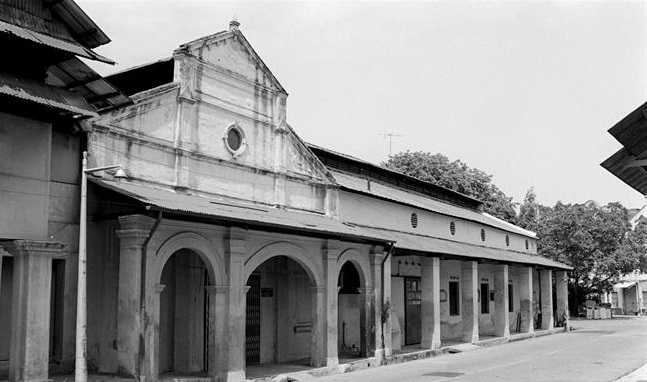
There’s Saer. It’s ten past eleven in the morning, the time he asked to meet at this splendid café Las Delicias in downtown Santa Fe. The idea was to chat for a while and plan the trip afterwards. Saer entered with his back to me and stood there trying to locate me in the middle of the café where, precisely, I am not. It takes him a few seconds, during which I decide to let him think he’s facing an invisible man. Saer is wearing the same outfit I saw him in back in Buenos Aires. Blue jacket, tea-colored pants, and a short-sleeved plaid shirt. His shoes look old. Saer, a son of Syrians who looks a bit like Alberto Sordi, never seems to have spent more time in Paris than here, on San Martín Street in Santa Fe.
This café of Viennese inspiration represents, for the writer, the architecture that returned this city to him through the eyes of a stranger, a thousand kilometers to the north. It was in a winery, in Paris, decades later, that an almost ancient Frenchman recognized Saer’s Argentinian identity and linked it to Santa Fe, first, and later to this place, Las Delicias, through the memory of “the lady on the hammock,” a myth anchored in some dance night between 1927 and 1937.
“I didn’t know the lady on the hammock but I found out she existed. They were the most beautiful sisters people in the city talked about,” says the writer.
He came to this city from the countryside ten years ago. In the 60s there was already a café here, but Saer, then a poet and a key contributor to the independent theater circuit, frequented another place a few blocks from this table we are at now, where he bites into a mil hojas (“a thousand leaves” pastry). “Mil hojas! This is a Santa Fe-style alfajor, a real panzer of breakfast. Cultural appropriation!”
His favorite was the gallery café, the first gallery that existed in Santa Fe, always known simply as “the gallery.” It’s impossible not to imagine the ghosts/characters of Saer at that bar: Tomatis, Barco, Leto, Garay, the Mathematician, and those women of devastating irony who populate his writings. All those creatures, names Saer pulled from the general store of his family in Serodino, have been, and still are, every time someone reads, walking down this very San Martín street that Saer looks out on from the tables of Las Delicias.
I tell Saer that many of his readers imagine that these characters live, breathe, love, are real men and women that he encounters on each journey like some sort of secret spring. That they ask themselves, for example, if Carlos Tomatis, his supposed alter ego or at least his favorite character in his stories and novels, is in fact Saer. Is he?
“Not at all,” Saer interrupts. “Many people have asked me that. All the characters have something of me and something that doesn’t. Tomatis has many elements of mine, as do other characters, even female ones, who have them too. Fiction contains autobiographical elements but its only goal is fiction itself. Look: in my new novel, Tomatis has a whole theory about Oedipus Rex. That’s his, not mine. I don’t have any theory.”
— Come on, you’re the one who writes the words…
— “I don’t treat a text as something tangible, and the same goes for the characters. We don’t know people in a linear way like we know ourselves in the novels of Isabel Allende, from beginning to end. I tend to sketch out the explanations. Even though many of my stories are composed in clear lines, speaking in terms of plot. But that clear line is never sufficiently explanatory in terms of the storyline. I try to give everything I write a certain opacity.
—Aren’t you afraid of hermeticism?
—No. I don’t do it out of whimsy, to exclude the reader, but because that’s how I perceive the world. My brother died three years ago and I swear there are things that can’t be said. I want to convey that. That’s why my stories always have an open ending. I call it “the poetics of disappointment.” I believe that opacity, which we inherited from Joyce and Kafka, is part of the art of the 20th century. We find it in painting, music, in a series of phenomena explored in that century.
Later, at dusk that morning, at 160 kilometers per hour, on the return to Buenos Aires, he insists that his characters carry a peculiar anguish, which is composed of a murmur of the era that still endures in its modes. Thinking of the angelic losers of the beatniks, Saer says of them, and yes, they are the ones in the books and also the others, the ones from San Martín Street, the ones you can imagine sitting next to young Saer at the bar. “I mean the misfits. I myself never quite fit into the literary environment or the academic one. And that goes for everyone I know here, doesn’t it?”
The trip with Saer, then, had begun at the door of Las Delicias. Then Colastiné, Rincón, barranca of Saerian barbecues, where we lost our way for good with Saer directing the remís (car with driver) in the opposite direction, the Santa Fe riverbank and, afterward, setting course for Buenos Aires, Serodino, the place where he was born. Places within reach from San Martín Street but also in Paris, waiting to be rewritten and repopulated by the team of Saerian misfits.
Characters who never, but really never, went French. A mystery, isn’t it? Just like Saer’s accent, which doesn’t carry even a hint of French inflection. “It’s the job that causes me the most problems, I have to monitor it all the time. It’s a concrete and conscious vigilance: the barrier against Gallicism,” he would say.
SERODINO–BUENOS AIRES
“I don’t recognize anything, how much this has changed.” The car enters a street in Colastiné, kids pass by on their way to school, and Saer thinks aloud about this town, his last Argentine residence before settling in Paris. It’s here, in any case, the little pink house and “the furnished motel” where Saer and his wife Bibí Castellaro lived and worked. The abandoned motel can now be rediscovered as a magnet of literature, it appears in the novel La vuelta completa. And in the bucolic tale that Saer evokes: “We used to run the motel. One night Ortiz came to visit, who was a close friend of the owner. That night we took over the motel with friends. Imagine the scandal if the police had come: Juanele Ortiz and I in one bed, two minors in a mueblada, would’ve been a huge mess.”
There is much more to Colastiné, though Saer is ecstatic with the walk. A sulky passes by and I think about the distance between these Santa Fe marshes and the zone where Saer lives in Montparnasse, Paris.
—And you left from here to Paris, non-stop?
—Yes.
—And?
—It’s a big change!
—Yes. There are no suburbs in Paris.
The writer recommends surubí (a native fish) next. He suggests we have lunch at the old Castelar Hotel in the city of Santa Fe, and he’s not wrong. In a short time, with the immaculate grease of the Paraná delicacy still on the palate, we pick up Saer at his sister’s house and take the Santa Fe–Rosario highway toward Serodino, on an afternoon undecided between rain and sun, before heading back to Buenos Aires. That evening, this same road was like one of the gloomy, Goyaesque landscapes that director Peter Jackson envisioned for The Lord of the Rings saga. A misty darkness stalking a fierce storm’s eye, all the beastliness the cosmos can show from here: the place, according to Darwin and Saer in The River Without a Shore, that’s the flattest on Earth.
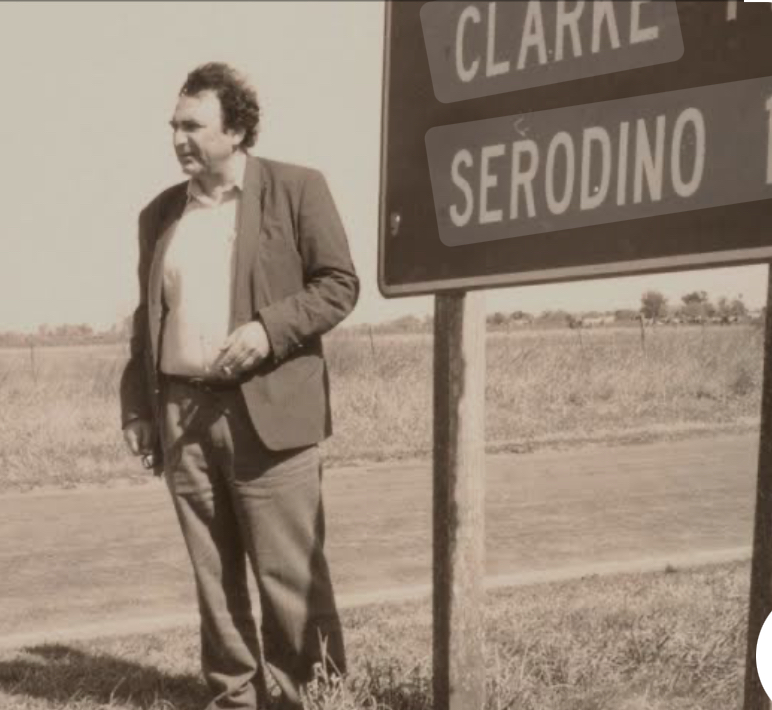
Serodino. There’s an absurd toll, a straight road, the ghost of a small train station that closed in the ’50s, a boulevard, a nephew Saer doesn’t know. A white house, like others, that our guide reinterprets.
“On this sidewalk, I had a dream when I was five years old. I dreamed that my mother had died, that she was lying there and that there were angels playing trumpets to wake her up.” It’s the first manifestation of the subconscious that the writer recalls. And here it is.
The pavement ends. On the other side of the boulevard, there is a construction from the late 19th century, with weeds sprouting like hair on an old skull. “This was my house. With the storage room included, even though it’s been abandoned for years.” A photo? “No, let’s keep going, too many people here. I’d feel embarrassed. Let’s walk down this block, where no one knows us.” We walk, a few stray dogs follow us, we see the house of Saer’s grandparents, the Anoch bakery, things that are upside-down or maybe reversed, the old Serodino train station that once ran up to Tucumán, now dead. It’s now a library: Saer donated his books and journals. Someone opens the door and pops their head out: “Do you need something?” Saer says no, he just wanted to see it again.
Two hundred meters ahead, the countryside swallows up Serodino, like a toad swallowing an insect, and we’re back on the road.
We pass Arroyo Seco, Fighiera, Villa Constitución, Theobald, Ramallo. We pass Kirchner (“declaring oneself Peronist is impossible, but Kirchner is a model of overcoming”), the seventies (“I hated the Montoneros of the immediate left, they had nothing to envy of the more criminal right”), Piazzolla (“he wanted to make tango the continuation of baroque music. I like it only at the beginning”) and Borges (“I was one of the first to vindicate him from the left”).
We pass Rosario. “Let’s keep going. If we stop, we’ll have to visit the cabarets, to see the girls I used to see in my youth, in the hospice, of course.” Saer jokes, the car bursts into laughter. In a few hours, he’ll push open the swinging door of a hotel on Arenales Street, and who knows, maybe this dreamlike journey through the geography of his work will replay again.
There he goes, the man who swears that the end of capitalism, well, lies in the voluntary sexual union of the young and old.
Everyone knows, or should know, that the novel is a form adopted by narrative to represent a vision of reality during the age of the bourgeoisie. According to Lukács, the tension within the novel between the protagonist and the world is not merely a question of historicity, but a limit that points us toward its imperfection. From a certain point of view, realism signifies the sufficiency of writing grounded in a vision of man who is exhausted by history. The origin of realism is found in comedy – in other words, the art of the real. Cervantes, the father of realism, introduces narrative into comedy, as the source that guarantees historicity.
Recognized as the avatar of narrative, the function of the novel emerges within a well-defined historical period that would be absurd to eternalize. For the great narrators of the twentieth century, from Joyce to the authors of the New Novel, the principal objective is to break through the barrier imposed by the concept of flawless historicity. For Joyce, symbolism is the dialectical opposite of realism. For Kafka, the line between parable and allegory is blurred. In Pavese or Mann, an epiphany is uncovered within the cultural domain during the course of a mythical search, and in general, it transcends mere historical reality.
In Argentina, two writers dissolved these problems: Macedonio Fernández, who did so radically, and his disciple, Jorge Luis Borges. Their critiques of the novel began as early as the mid-1930s and, through their anachronistic practice, transformed the trajectory of narrative in the Spanish language ever since.
I fully adhere to the position of Macedonio Fernández, and I believe his Museum of the Eternal Novel is an unprecedented feat in the Spanish language. One cannot ignore the reasons why Macedonio opposed the novel, because his critique of the novel is fundamentally a critique of the real. Consequently, my first preoccupation as a writer is with what is presented to us as reality, the supposedly unquestionable real to which everything else is subordinated. Being Argentine, for example, is part of the puerile reality that requires, like everything else, careful examination. I do not write to assert my Argentine identity, although this may frustrate the expectations of many readers, especially non-Argentinians. I do not speak as an Argentine but as a writer. Narrative is not produced as an ethnographic or sociological document. The narrator is not a designated spokesperson charged with representing the totality of a particular nationality.
European critics often regard Latin American literature through the lens of what they consider “Latin American” traits. To me, this is confounding and dangerous. Such preconceptions confine writers within the ghetto of Latin American-ness. If a writer’s work does not match the European reader’s immediate image of Latin America, it is often read as a sign of inauthenticity, especially if the writer seems “too European.” Certain features, both formal and thematic, have been stereotyped as Latin American by Europe, and many Latin American writers reinforce this by aligning nationalism with anti-colonial resistance. Yet the nationalism of the colonial master and that of the colonized should not be studied separately, because both stem from the same ideological structure.
Three dangers loom over Latin American literature. First, the assumption that a writer must be presented a priori as Latin American. But literature is not tasked with investigating the traits of nationality. When nationality becomes the point of departure, any imperfection in the work is deemed unacceptable, and the text becomes closed off from other sources. The greatest error a writer can make is to believe that being Latin American is, in itself, sufficient reason to write. What is considered “Latin American” should be secondary, something one might happen upon. Particularity does not come from one’s place of birth but from the work itself. As Hölderlin wrote to Böhlendorff on December 4, 1801: “When culture progresses, national essence is always of the least interest.” To claim national identity as literary substance is to simulate, to perpetuate the old ideological masks that prop up the status quo. Among the many layers that constitute reality, national specificity, fortified by morality and politics, should be the first to be questioned for how indisputable it seems.
This demand to represent one’s country leads to two further dangers that lurk behind literature. The first is vitalism, the ideology of the colonized. This is a sophistic narrative that links our underdeveloped economy to a supposed intimacy with nature. It gives rise to excess and exaggeration: the cliché of unrestrained passion, occultism, the best-selling genre of magical realism, and the romanticized image of vast continental terrain equated with primitivism. The Latin American is cast as a noble savage, constantly at odds with untamed natural forces. The second danger is voluntarism, born of our dire social and political conditions. This sees literature as a direct instrument of social transformation, used to illustrate principles that have already been defined. Naturally, in the face of state terror, exploitation, and political violence against the working class or individuals, we desire immediate and absolute change—but this is not the function of literature.
From the beginning, the narrator has nothing more than a negative theory. What is formulated is of no practical use. Narrative is a practice that, as it unfolds, secretes its own theory. Before writing, one knows only what not to do. What remains, what one ends up doing, is the result of ongoing decisions made during the process of composition. The statement, “Given that I am Latin American, and that we Latin Americans must describe what we are,” is typical of a certain ideological attitude. But it is also tautological. If one is already recognized as Latin American, it is pointless to declare it.
Historical, political, economic, and social problems demand precise solutions grounded in appropriate methods. Displacing the singularity of literary practice is a form of naïveté, opportunism, and bad faith. This bad faith stems from the discomfort writers feel when confronting the particularities of their work within their historical moment. There are two possible responses. One is to limit oneself to the voluntarist repetition of social conditions, it is a mistake. The other, which appears to me as the only viable path, is to begin from the discomfort itself: to analyze one’s experience and let that analysis emerge in the writing.
The novel is merely a literary genre. Narrative is a way of relating man to the world. Being Latin American neither places us outside this truth nor exempts us from its demands. To be a narrator requires an immense readiness, for uncertainty, for misunderstanding, even for oblivion. This applies to all narrators, regardless of nationality. Every narrator lives in the same place: the dense, virgin forest of the real.
Ng Sua Ping, a Teochew Singaporean, grew up in the Robertson Quay area, also known as Au Pa Yoh, or Chwee Long Lai. He didn’t complete secondary school and was orphaned at eighteen. As a child, he had once unwittingly warned a young British soldier at Bugis Street night market about a pickpocket. Grateful, the soldier befriended him and showed him painted postcards of landscapes. “I’m Scottish, not English,” he liked to say, and told Ping he was applying to art school back in the UK. He lived in the single-men’s quarters within the Beach Road Police Station compound, a barracks shared by unmarried and married men, with dorm rooms, communal mess halls, and recreation spaces. Ping remembered entering it once, led by the soldier, and seeing how the men lived. From the third storey of the barracks, he looked out toward the sea and the beach. As he watched the waves recede and rush back against the sand along the coast, a picture formed in his mind, an idea stirring quietly within him.
Inspired by the painted postcards shown to him by the soldier, Ping began to paint beaches, scenes that were timeless, placeless, ahistorical, almost imagined tropical paradises, copied from magazine clippings and second-hand travel books. He sold them to an Indian shop near the General Post Office, in the tourist district, turning it into a modest source of additional income.
Twice he applied to the Nanyang Academy of Fine Arts but failed the entrance exams. He remembered the man who gave feedback, an administrator or teacher, holding a cigarette, saying he needed more practice before reapplying. Ping felt his eyes burn when he heard it the second time; he wasn’t sure if it was the smoke or the sting of rejection. He noticed the students who passed through the school’s entrance wore better shoes and spoke with confidence. They came, he thought, from better backgrounds. He wasn’t sure he would fit in.
In the 1960s, he often loafed along Robertson Quay with a group of friends. Once, when a Punjabi guard had dozed off, they snuck into a warehouse near the now-erased Pukat Road, just off Martin Road. It had once been a glass factory, the floor still glittered with fragments that resembled tiny shards of ice and powdery frost, the kind that would never melt in tropical heat. He wondered why glass, whole, remained clear, yet turned frosted and opaque when broken.
Despite the glass scattered across the floor, the warehouse was filled with sandbags. It was said that these sandbags had been packed into containers and sent to U.S. troops in the Vietnam War. The bags were made of coarse burlap, rough to the touch, stitched like hastily patched skin. The sand inside held firm, refusing to slip away; his friend said they could be used as punching bags. But one sack had a hole. He dug his finger into it and felt the coarse density, slightly damp, stubborn, unshifting.
In the early 1970s, Ping left Singapore to work for his Thai-Chinese uncle in Pattaya, who ran a modest hotel and, quietly, worked as a pimp. His uncle liked to say that Pattaya had been a sleepy fishing village before the American soldiers came. Ping thought of how people said the same about Singapore – that before Raffles, it too was a sleepy village. Everywhere, it seemed, was sleepy before the Europeans arrived, he mused. The sex tourism trade here, his uncle said, wasn’t born of tradition, it was invented to solve the economic problems of a feudal, stratified society. His uncle also sold postcards of beaches, though now they were photographs, not paintings.
One evening on the beach, Ping walked barefoot, feeling the sand between his toes. He grabbed a fistful. Pale, soft, almost powdery, and let it sift through his fingers, like time like he could not hold. He thought of the sand in the warehouse years ago, coarse and tamped down. In a world unraveling, those bags had held their shape.
He remembered once being told to clean up a room vacated by a U.S. soldier, someone who had left, or perhaps disappeared, without paying. Disappeared, it seemed, because all his belongings were still there. As Ping rummaged through the room, hoping to find cash or something of value, he pushed in his whole hand into a duffel bag. At the bottom, he felt a trace of sand. It was coarse, just like the sand from the warehouse at Pukat Road.
He also found a strange book. On the spine: Holy Writ. Bombay. Inside, the pages were worn and cramped, printed in double columns like a Bible. But the numbers were odd: page 50,908, followed by 999, then an eight-digit figure. There were small drawings too: a helmet, a strange fish, inked in the clumsy hand of a child. He closed the book. Later, he threw it away with the rest of the items.
When his unmarried uncle died, Ping continued running the hotel. His Thai became fluent. He married a local woman and had four children. After the war, the clientele changed: the soldiers were succeeded by an invasion of tourists. Pattaya carried on a young legacy of desire and transaction.
“An arena where war and leisure blurred. It was both missile trails and fireworks in the night sky. Play and violence, festival and war, in the anthropological sense, were not opposites but excesses of the same human impulse. In ancient Rome, the arena was the central pit of an amphitheatre, its sand meant to soak up blood from combat. Over time, the word came to mean the whole place of spectacle, not just the sanded floor.” This is was what a tourist from Spain once told him, or at least, he recalled it as such. The man had said that in Spanish, la arena means “sand.”
From then on, the word held both meanings for Ping: not just the beaches and wave pictures, but the battlefield too. Many years later, back in Singapore, he was walking along the Kallang River during National Day celebrations when he saw fireworks in the night sky, he related it to the roar of fighter jets earlier. He thought of the word again, and of the type of sand he had once felt.
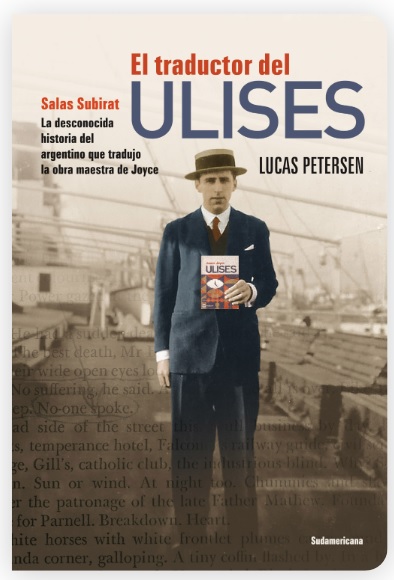
One afternoon in 1967, the author of this article witnessed the following scene: Borges, who had traveled to Santa Fe to speak about Joyce, was chatting animatedly in a café with a small group of young writers who had come to interview him before the conference. All of a sudden, he recalled that in the 1940s he had been invited to join a committee that intended to translate Ulysses collectively. Borges said the committee met weekly to discuss the preliminaries of this monumental task, which the best anglicistas of Buenos Aires were preparing to undertake. But one day, after nearly a year of weekly discussions, one of the members showed up brandishing a massive book and exclaimed, “A translation of Ulysses, just published!” Borges laughed heartily at the incident, and even though he had never read the translation (and probably not the original either), he concluded: “And the translation was very bad.” One of the young writers listening replied, “Maybe, but if that’s the case, then Señor Salas Subirat is the greatest writer in the Spanish language.”
This response reflects the attitude toward translation among young Argentine writers during the 1950s and 60s. The 815-page book had been published in 1945 by Editorial Santiago Rueda of Buenos Aires, which also released A Portrait of the Artist as a Young Man in a translation attributed to Alfonso Donado (read: Dámaso Alonso). The publisher’s catalogue also included major authors like Faulkner, Dos Passos, Svevo, Proust, Nietzsche – not to mention the complete works of Freud in 18 volumes translated by Ortega y Gasset. In the late 1950s, these books circulated widely among those interested in literary, philosophical, and cultural issues of the twentieth century and were essential holdings in any serious library.
The Ulysses by J. Salas Subirat (the initial “J.” giving his name a mysterious aura) often came up in conversations, woven into the endless stream of speculative discussions left deliberately open-ended. Anyone between 18 and 30 with a passion for narrative in Santa Fe, Paraná, Rosario, or Buenos Aires knew the book by heart and could quote it line by line. Many writers of the 1950s and 60s learned much of their narrative technique and acquired many of their resources from that translation. The reason is simple: the turbulent current of Joycean prose, rendered into Spanish by a man from Buenos Aires, carried with it the living energy of spoken language, something that no other author, except perhaps Roberto Arlt, had used with such ingenuity, precision, and freedom. The lesson was clear: the language of everyday life was the source of energy that nourished the most universal literature.
Although it was the first translation, its merit may not lie solely in intrinsic quality. Still, it is vulnerable to two opposing but related dangers: biased criticism and intellectual pillaging. This has long been the fate (though some are beginning, albeit reluctantly, to correct it) of Salas Subirat’s extraordinary effort. It is unacceptable that the translator of a second version of Ulysses into Spanish would claim ignorance of the first. Yet this seems to have been the stance of Professor Valverde, who offers justifiable praise in the 46-page preface to his version, which was published by Dámaso Alonso, but says nothing about Salas Subirat’s translation. A comparison of the two reveals that Valverde’s silence likely stems from an obsessive desire not to resemble the earlier version. No serious translator of Ulysses today can ignore the first and second versions, this is the honest approach adopted by Francisco García Tortosa and María Luisa Venegas in their third translation, and such acknowledgment means that all translations become necessary reference points. However, Valverde’s version appeared with a kind of disdainful righteousness, as if it had arrived to correct the supposed ineptitude of the first. On the internet, natural homeland of the absurd, one finds not only various misrepresentations of Salas Subirat’s translation, but also a commercial travesty: the 1996 “massacre” by a man named Chamorro, who claimed to have corrected “up to 50%” of the original version. He criticized, among other things, its use of Buenos Aires colloquial speech, as if a Londoner translating Ulysses would have stripped Dublin slang in favor of Oxford English. This act of piracy, fifty-one years after the book first appeared, leads one to observe that “it is, in some ways, merely a repetition of Salas’s translation.”
Writer Eduardo Lago has compared the three authentic translations (wisely excluding Chamorro’s act of vandalism), and he does not award any one of them a perfect score – and rightly so. It would be rash to claim that any version is definitively superior. Lago’s comparison is impartial and meticulous, and his close reading of different passages shows what was already evident in the first two translations: that the authors managed, with relative success, to resolve the challenges of the original. The purpose of a translation is not to show off the translator’s erudition or mastery of the source language, though both are certainly required, but to integrate the original into the living language of the target culture. In every era and every linguistic field, new translations of classics are necessary. But this need should not entail the denigration of earlier versions.
José Salas Subirat, neither Catalan nor Chilean, as some vague reports in literary journalism have claimed, was born in Buenos Aires on November 23, 1900, and died in the town of Florida on May 29, 1975. He is buried in the Olivos cemetery. He was self-taught and worked, among other things, as an insurance agent, even writing a professional book titled Life Insurance: Theory and Practice. Information Analysis was published in 1944, just a year before he completed his Ulysses translation. In the 1950s, he also published self-help books like The Struggle for Success and The Secret of Concentration, and an open letter on existentialism that James Wheel included in his catalogue. But he had also written social novels, poems (Signalero), and articles for anarchist and socialist publications during the 1930s.
Could it be that because I have been wandering throughout the week, Saturday and Sunday have become the most boring days of my life? I think Sunday is pure old boredom, and English Saturday is a sad day, with sadness characterized by the name of the race.
English Saturday is a colourless and tasteless day; a day “with neither kicks nor pricks” [no corta ni pincha] in the routine of the people. A hybrid day, without character, without gestures.
It is a day for marital brawls to thrive, and for drunkenness more lugubrious than the De Profundis in the twilight of a cloudy day. A grave silence hangs over the city. In England or Puritan countries, that is. The lack of sun, which is surely the natural source of all joy. And when it rains or snows, there is nowhere to go, not even to run. So people stay at home by the fire, and, tired from reading Punch, they browse the Bible.
But for us, the English Saturday is a very modern gift that failed to convince. We already have plenty of Sundays. Without money, nowhere to go, and no desire to go anywhere, why would we want Sunday? Sunday was an institution humanity could live without very comfortably.
Daddy God rested on Sunday because he was tired of having made this complicated thing called ‘world’. But what has been done during the six days, all those slackers out there walking around, to rest on Sunday? Besides, no one has the right to impose a day of idleness. Who asked for it? What for?
Humanity had to impose a day from the week dedicated to doing nothing. And mankind was bored. A ‘lean’ day is suffice. Here comes the British gentleman — what a great idea! Let’s add another day more, on Saturday.
Regardless of the amount of work, one day off per week is more than enough. Two are unbearable in any city in the world. I am, as you see, a sworn enemy of English Saturday.
The necktie used for a week left in the trunk. Suit with ostensible stiffness well-kept. Boots creaking. Glasses with gold frame, for Saturday and Sunday. And this is the self-satisfying aspect that made you want to kill him. Like the kind of boyfriend, one of those couples that bought a house on monthly installment. One of those couples kissing to fixed term.
So carefully polishing his boots when getting out of the car that I did not forget to step on one of his feet. If there had been no people, the man would have killed me.
After this fool, there is another man on Saturday, the sad man, the man who grieves me deeply every time I see him.
I’ve seen him numerous times, and he has always given me the same painful impression.
I was walking down a sidewalk one Saturday, under the shade, by Calle Alsina – the most dismal street of Buenos Aires – when, on the opposite sidewalk, along the path of the sun, I saw a hunchbacked employee walking slowly, carrying a three-year-old child.
The creature exhibited her innocence with one of those little hats with cintajos, already deplorable without being old. A freshly pressed pink dress. Some shoes for the holidays. The girl walked slowly, and the father, even more slowly. And suddenly I had a vision of the room in a lodging house, and the mother of the child, a young woman wrinkled by hardship, ironing the baby’s hat with cintajos.
The man walked slowly. Sad. Bored. In him I saw the product of working twenty years by the sentry box, of fourteen hours a day and with starving wages. Twenty years of deprivation, of stupid sacrifices, and holy terror of being fired and left unemployed in the street. I saw him as Santana, the character by Roberto Mariani.
And the city centre on Saturday afternoon is horrible. When businesses are exposed in hideous nakedness. The metal shutters have aggressive rigidity.
Basements of importing houses vomit the stink of tar, benzol and overseas items. Stores stink of rubber. The hardware stores, of paint. The sky seems so blue, as if it were illuminating an inconspicuous factory in Africa. Taverns for stockbrokers remain empty and dismal. A gatekeeper playing mus with floor cleaners by the edge of a table. Guys procreated by the spontaneous generation of moss-covered benches appear at the door marked “employee entrance” of the cash deposits. And one feels the terror, the awful horror, of thinking that at the same hour, in many countries, people are forced to do nothing and yet are willing to work or die.
Notes:
cintajos: Decorative ribbons or sashes, often sewn onto children’s hats or dresses. A quaint, old-fashioned detail evoking domestic care and modest festivity.
mus: A traditional Spanish card game, typically played in pairs. Popular in taverns and social clubs, especially among older men; more for ritualised banter than for gambling.
Santana: A character from El hombre de la calle by Roberto Mariani, a writer associated with Buenos Aires’ early 20th-century proletarian literature. Santana embodies the quiet desperation of the urban working class: overworked, underpaid, and resigned to an existence of silent suffering.
Fred Tan was a Singaporean born in 1970. Some of the people remembered him for his love of music and books, enduring loyalty to obsolete forms, his belief in unseen influences, and his quiet resistance to the logic of substitution. His life, though modest in outward appearance, was shaped by a series of private disruptions, each reinforcing his preference for routine, and permanence over adaptation and change.
Tan grew up in a conventional household and, during his formative years, developed a mild interest in reading and writing. His formal exposure to literature came through secondary school and A-Level studies, where he developed a fondness for poetry, drawn to its rhythms and resonances, which he found echoed in song lyrics. However, he did not proceed to university, having achieved only modest examination results for A Levels. Much of his literary sensibility was formed outside academic institutions, and an informal study of music and literature from places such as Tower Records and Borders.
Since early adulthood, Tan held a series of night-time jobs. As a student, he began as a printing assistant and later worked in a factory on an assembly line, then still common in Singapore. During national service, he was posted to the police force, where he frequently took night shifts. Later, he worked as a pub waiter. In his fifties, he found work as a night shift security guard in condominiums, and warehouses across industrial estates. These occupations suited his temperament, allowing him to remain slightly apart from the rhythms of the day. The solitude of the night shifts gave him time to reflect, to read, and to listen to music, but it also deepened his quiet sense of dislocation from the society that passed by while he watched.
Tan’s approach to music mirrored his wider resistance to technological and cultural change. He began listening to vinyl records during his youth, later adapting, somewhat reluctantly, to cassette tapes. When CDs replaced cassettes, he made the transition out of necessity rather than enthusiasm. He refused, however, to embrace digital formats such as iPods or mobile phones, complaining that music played from these devices lacked the tangible weight and texture of earlier media. For Tan, sound was a physical phenomenon, intimately tied to memory, and memory to the body. He kept a vast CD collection, even though he no longer owned a player. Like his music, his domestic life followed a logic of attachment over replacement: a quiet refusal to discard what had once held meaning. Likewise, he would never buy a book online without first holding the physical copy in his hands.
For a period, Tan lived with his aging parents, eldest brother, and sister-in-law in a shared HDB flat. His second brother works abroad, and he had the room he used to share for himself. However, tensions gradually accumulated, especially with his sister-in-law. During her pregnancy, Tan occasionally overheard arguments between his brother and sister-in-law, often centering on the strain that their living arrangement was placing on their privacy and future plans.
Although he wished to move out, Singapore’s public housing policy, which prevented unmarried individuals under the age of 35 from purchasing their own flats, left him with few options. Contrary to later assumptions that he had always been solitary, Tan was not someone destined for bachelorhood from the outset. While he was introverted and rarely attracted the opposite sex, he had formed a sincere and meaningful relationship in his early thirties with a woman he met through work. It was, for a time, a sign of emotional potential, perhaps even the possibility of a settled domestic life. But that possibility never materialised. His only girlfriend, Susanne, died during the SARS epidemic in the early 2000s. Her death left an irreparable wound, shaping his later refusal to seek new attachments or accept substitutes for what had been lost.
Tan rented a room from a retired carpenter in a peculiar towering HDB block, an uncommon design of vertically stacked units, now demolished. The carpenter’s flat, which smelled of varnish and sawdust and was offered at a low rate, carried a quiet but troubled history. The previous occupant, a Malaysian man, had died in a motorcycle accident; neighbors whispered that the carpenter has a son had later disappeared under mysterious circumstances, with some suggesting suicide. Though unconfirmed, these rumors contributed to the heavy atmosphere surrounding the unit. The block itself, with its labyrinthine layout, low parapet walls, and disjointed corridors, caused Tan vertigo whenever he looked down, and produced a subtle but persistent disorientation. Over time, Tan grew increasingly withdrawn, sensing in the building’s strange geometry a reflection of his own internal dislocation.
Tan once said, “Astrology is not superfluous to a person’s life story. Don’t be averse to noticing the stars at night.” People once, he said, looked to the heavens to consider their futures. The word consider comes from the Latin considerare, meaning to observe with the stars. Because of his occupation and his casual references to astrology, many assumed Tan was just another frivolous unintellectual reader of the horoscope column printed weekly in newspapers, indulging in low and vulgar superstition. They were half right. He did read it religiously, not as a guide, but as a dictation. In another era, Fred Tan’s reliance on astrology might have seemed natural, not eccentric: a way to impose structure on uncertainty. For him, it was not superstition, but a necessary framework, an architecture for interpreting the world’s instability.
In mid 2010s, another quiet but significant loss occurred: the newspaper from which he had drawn his daily horoscope ceased publishing its astrology column. Though alternatives existed online, Tan refused to substitute. Its disappearance mirrored, in miniature, the earlier loss of Susanne, another trusted orientation point quietly erased without substitution.
Seeking coherence amid personal loss, Tan immersed himself in the study of astrology. In the quiet reference section of the National Library, he came across a linguistic thread that felt like revelation. The word influenza, he learned, originated in 14th-century Italian, derived from the Latin influentia, meaning the influence of celestial bodies on earthly events. During a major epidemic in the 18th century, Italian physicians used the phrase “influenza di catarro” – influence of catarrh – to describe a respiratory illness marked by excessive mucus. Over time, the phrase was shortened simply to influenza, and when the epidemic spread across Europe, the English borrowed the term wholesale, stripping away the celestial context but keeping the name. Flu emerged later as a casual abbreviation. For most, this was a linguistic curiosity. For Tan, it confirmed a worldview he had long intuited: that diseases, SARS included, the one that took Susanne, were not merely biological mutations, but visible symptoms of cosmic imbalance. To him, the virus was not chance. It was a star’s long, delayed echo.
During this period, Tan had depression and it gradually developed symptoms of pseudo-aphasia, a language disturbance arising not from brain injury but from profound depression. His speech became halting, fragmented, and hesitant. His spatial perception also deteriorated. He began having difficulty distinguishing between private and public spaces, sometimes confusing corridors, void decks, and rooms. On occasion, he performed private acts, intended for the seclusion of a room, in semi-public areas, apparently unaware of the boundaries he had once observed.
However, a fortune teller at Waterloo Street, an expert in Fengshui, the traditional practice of arranging space, furniture orientation, and architecture to optimize the flow of energy, told him that it wasn’t just the alignment of stars that had influenced him. Initially, Fred was skeptical. But when he followed her advice, and bought some expensive items from her, there was a slight improvement, though perhaps it came too late.
The rearranged furniture and the auspicious objects he hung did seem to help. The altered layout, guided by Fengshui, briefly improved Fred Tan’s mental state, containing the edges of his madness. But what lingered most were the stars, celestial, faintly visible from the window of the tower block, no longer sharp, just dulled glimmers drowned by the city’s terrestrial glow: streetlamps, lit windows, and passing headlights. In May 2021, during Singapore’s second wave of COVID-19, part of the resurgence that had killed nearly 481,000 in India, Fred contracted the virus and died. Until the end, he insisted it wasn’t the virus that had harmed him, but the stars. He thought of this while on respiratory support, with no one to tell, or perhaps simply unable to. He believed the cause lay in the influences, the silent, indifferent stars we no longer interpret. Others still argued: it wasn’t the stars, it was the room. Some said it was both. And only one person, passing through the void deck, paused at the sight of his CD collection left by the rubbish chute, and thought: perhaps this was the true influence, the quiet music of his youth, that had determined his destination all along.






 illiteratus.com